Boscia arabica Pestal.
For people
- Eaten by people
- Unknown
- Toxic to people
- Unknown
For livestock
- Grazed by livestock
- Limited fodder
- Toxic to livestock
- Unknown
Edibility and safety notes
No reliable information was found on whether people eat any part of this tree or whether it is poisonous. The fruits of some African Boscia species are eaten, but that cannot be assumed for this species, so do not eat it. The field guide states only that camels browse it; no report of harm to livestock was found.
This guide is a hobby project, not expert advice. Never eat a wild plant, or feed it to animals, on the strength of this page alone. Read the disclaimer
Description
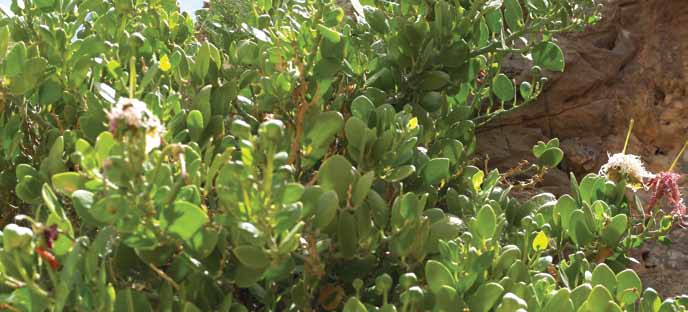
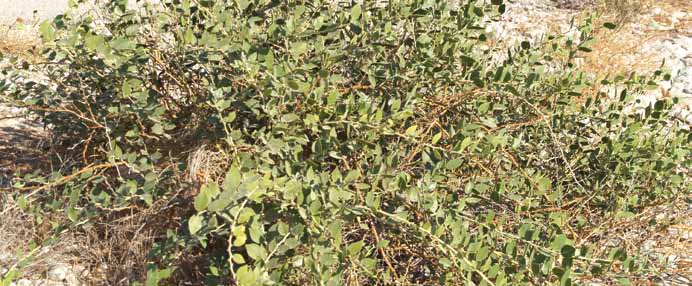
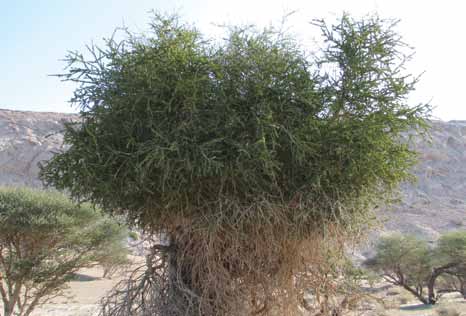
A small evergreen tree up to 5 m tall with a dense, flat crown and smooth grey bark. Leaves simple, without stipules, alternate (sometimes clustered), 8-30 mm long and 3-12 mm wide, obovate, rounded to notched at the tip and rounded to wedge-shaped at the base, hairless to downy. Flowers pinkish, in axillary racemes. Sepals four, 3-4 mm, bending back at flowering; petals absent. Stamens 6-8, protruding. Ovary borne on a stalk (gynophore) 5-7 mm long. Fruit ovoid, 5-8 mm long, green when ripe. Flowers and fruits in September.
Habitat
Mountain cliffs and escarpments.
Distribution
Endemic to the southern Arabian Peninsula: Oman (Dhofar) and Yemen.
Pastoral value
Browsed by camels.
Sources
- كتاب نباتات عمان
- GBIF backbone — Boscia arabica Pestal. — api.gbif.org
- Wikipedia — Boscia arabica (Oman and Yemen; IUCN Vulnerable, Ghazanfar 1998) — en.wikipedia.org
- Plants of the World Online — Boscia arabica Pestal. (native range Oman, Yemen; seen in search result) — powo.science.kew.org
- Feedipedia — Boscia angustifolia (related species, for context only) — feedipedia.review.fao.org