Maerua crassifolia Foresk.
سرح، السرح، سريشحريت
For people
- Eaten by people
- Edible
- Toxic to people
- Unknown
For livestock
- Grazed by livestock
- Good fodder
- Toxic to livestock
- Not toxic
Edibility and safety notes
In the Sahel and West Africa the leaves are boiled and eaten as a cooked vegetable (sold in markets, made into soups), and flowers and fruits are also eaten; no Omani food tradition is documented. Leaves are bitter and contain saponins and tannins, so they must be boiled (often with a change of water) before eating; raw leaves can cause diarrhoea. The foliage and flowering shoots are a valued dry-season browse for camels and goats, less liked by sheep; PROTA notes it is not considered suitable for horses.
This guide is a hobby project, not expert advice. Never eat a wild plant, or feed it to animals, on the strength of this page alone. Read the disclaimer
Description
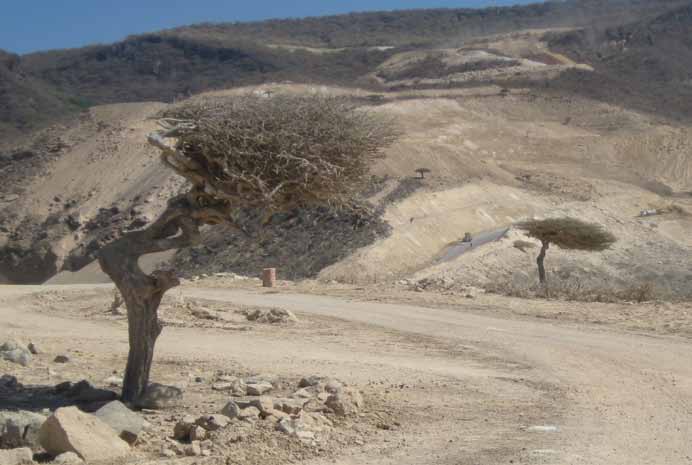
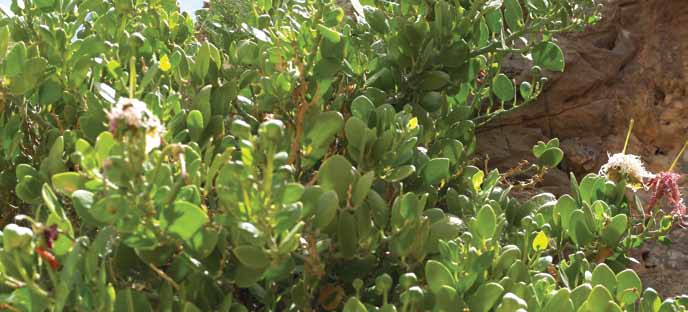
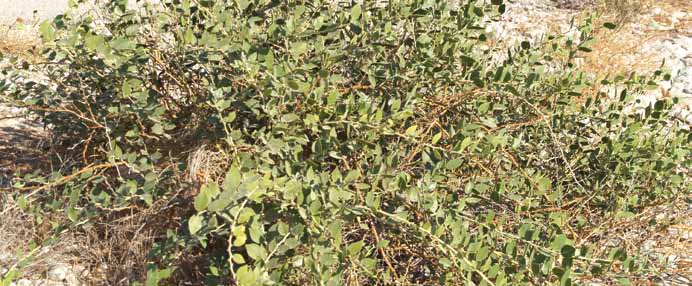
A scrubby shrub or small tree, 2.5-7 m tall, with several trunks and long arched upper branches. Leaves are thick-fleshy, oval-triangular, 12-20 mm long. Flowers lack petals, with four hairy reflexed calyx lobes and numerous stamens. Fruit is a short constricted, curled pod with one or several seeds.
Habitat
Cliffs, edges of rocky springs, wadi fans in hot deserts, deciduous bushland, thickets, and semi-desert scrub near rivers, from sea level to 1620 m elevation.
Distribution
Native to Sudano-Sahelian dry savannahs and deserts, from Mauritania and Senegal eastward across the northern Sahel to East Africa (Ethiopia, Somalia, Sudan, Kenya, Tanzania, Uganda), the Arabian Peninsula, western Asia, and Israel.
Pastoral value
Important fodder tree, especially for camels during the dry season. Foliage widely used as livestock feed in parts of Africa.
Other uses
Leaves eaten as a vegetable and locally traded. Crushed leaves and decoctions used to treat fever, stomach disorders, and skin infections. Wood is very hard, used for poles, handles, ploughs, and water troughs. Young branches widely used as chew sticks for dental hygiene.
Sources
- الدليل الحقلي المصور للنباتات البرية في سلطنة عُمان (BOOK.pdf p.69)
- Feedipedia — Atil (Maerua crassifolia) — feedipedia.org
- PROTA (Plant Resources of Tropical Africa) — Maerua crassifolia — plantuse.plantnet.org(PROTA)
- Wikipedia — Maerua crassifolia — en.wikipedia.org
- UAE National Red List — Maerua crassifolia (notes Oman Ru'us al-Jibal population) — nationalredlist.org
- Plants of the World Online — Maerua crassifolia Forssk. — powo.science.kew.org
- Feedipedia: Atil (Maerua crassifolia) — feedipedia.org
- Useful Tropical Plants: Maerua crassifolia — tropical.theferns.info