Imperata cylindrica (L.) Beauv.
حلفا
For people
- Eaten by people
- Edible
- Toxic to people
- Not toxic
For livestock
- Grazed by livestock
- Limited fodder
- Toxic to livestock
- Not toxic
Edibility and safety notes
People in Africa and Asia eat the young flower spikes and young shoots cooked as a vegetable and chew the sweet white rhizomes; no poisoning is reported. It is a minor food, and the rhizomes must be cleaned of soil. The edges of mature leaves are hard and razor-sharp and can cut skin. For livestock it is a poor-quality forage: camels, cattle and goats graze the young growth, but mature leaves are tough, sharp and largely avoided.
This guide is a hobby project, not expert advice. Never eat a wild plant, or feed it to animals, on the strength of this page alone. Read the disclaimer
Description
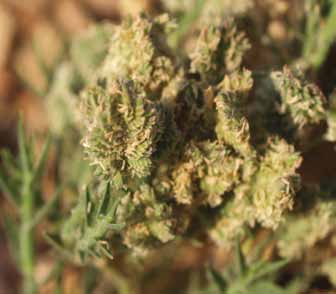
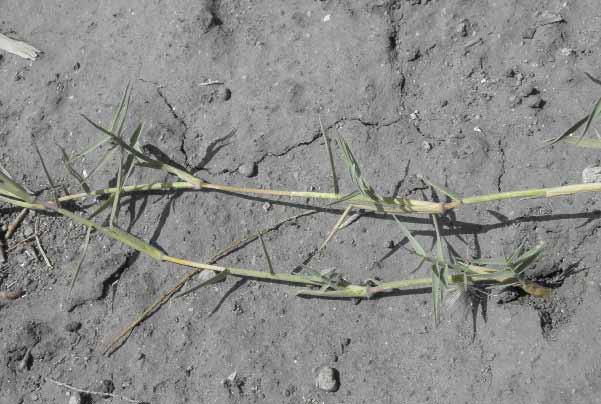
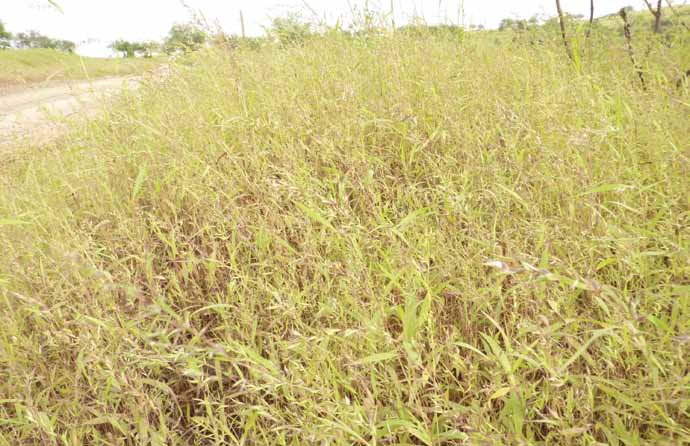
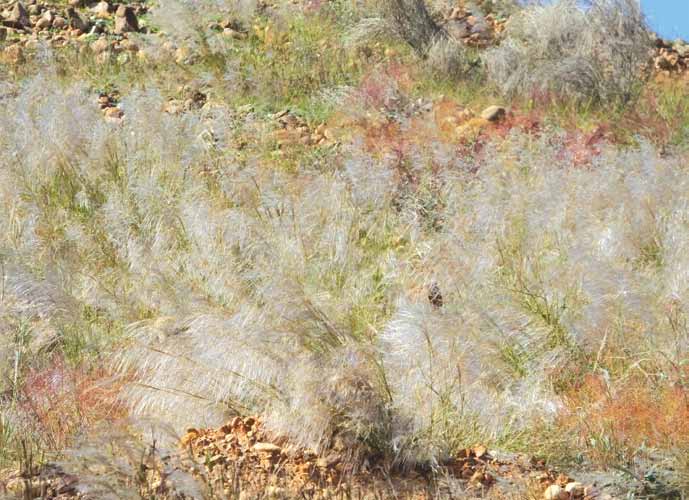
A perennial grass 30-150 cm tall with long, creeping rhizomes. Stems erect and smooth. Leaves flat, linear, rough to the touch, 5-18 mm wide, with hard, finely toothed, sharp edges when mature. Inflorescence a dense, cylindrical, spike-like panicle 5-20 cm long, silvery-white and silky. Spikelets 3-6 mm long, surrounded by long, silky white hairs, each with two florets, the lower sterile and the upper bisexual. Flowers from March to June.
Habitat
Dry sandy areas in Oman according to the Omani field guide. Elsewhere it is very adaptable and favours damp ground near swamps and drainage lines, cultivated and abandoned fields and roadsides; it tolerates drought, fire and some salinity.
Distribution
Widespread in the tropics and subtropics of Africa, the Mediterranean, the Middle East, Asia and Australia, between about 45 N and 45 S; in the Arabian Peninsula recorded from Oman, Kuwait, Saudi Arabia and Yemen. One of the world's worst weeds.
Pastoral value
Acceptable grazing for camels. Feed value depends on growth stage: crude protein reaches about 11.7% and digestibility about 70% in early growth, falling sharply with age. Overall a poor-quality forage; cattle, goats and sheep graze the young growth, while mature leaves are tough, sharp-edged and avoided.
Other uses
Leaves and stems are used for thatching and for weaving mats, baskets and rope, and for paper; the seed fluff is used to stuff pillows. Planted for erosion control. Rhizome decoctions are traditionally used in Africa and Asia as a diuretic. Young inflorescences and shoots are eaten cooked and the sweet rhizomes are chewed. Considered one of the world's worst invasive weeds.
Sources
- الدليل الحقلي المصور للنباتات البرية في سلطنة عُمان (BOOK.pdf p.159)
- PROTA (Pl@ntUse) — Imperata cylindrica — plantuse.plantnet.org(PROTA)
- Feedipedia — Alang-alang (Imperata cylindrica) — feedipedia.org
- Temperate Plants Database — Imperata cylindrica — temperate.theferns.info
- Plants of the World Online — Imperata cylindrica — powo.science.kew.org
- UF/IFAS Weed Risk Assessment — Imperata cylindrica (range incl. Oman) — assessment.ifas.ufl.edu
- PFAF: Imperata cylindrica — pfaf.org
- Pl@ntUse PROSEA: Imperata cylindrica — plantuse.plantnet.org(PROSEA)
- Wikipedia: Imperata cylindrica — en.wikipedia.org