Morettia parviflora Boiss.
عفرا، ثغر, علقى بيضا، خبيزة
For people
- Eaten by people
- Unknown
- Toxic to people
- Unknown
For livestock
- Grazed by livestock
- Limited fodder
- Toxic to livestock
- Unknown
Edibility and safety notes
No reliable information was found on people eating this plant or on any toxicity, so it should not be treated as edible; the local name 'khubaiza' is shared with the edible mallows (Malva), which are quite different plants. For livestock it is a minor grazing plant: the Omani field guide rates it as weak pasture, a 19th-century record from north-west Arabia notes it as eaten by cattle, and the UAE Red List mentions grazing pressure on it.
This guide is a hobby project, not expert advice. Never eat a wild plant, or feed it to animals, on the strength of this page alone. Read the disclaimer
Description
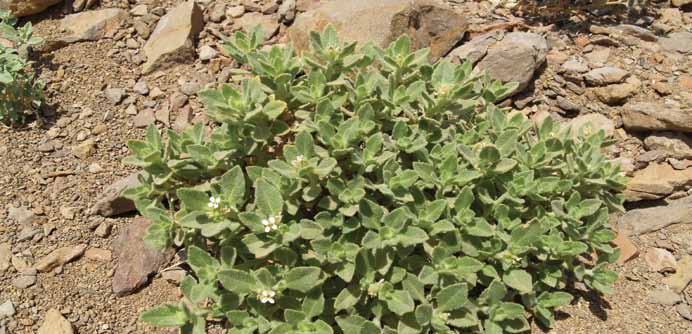
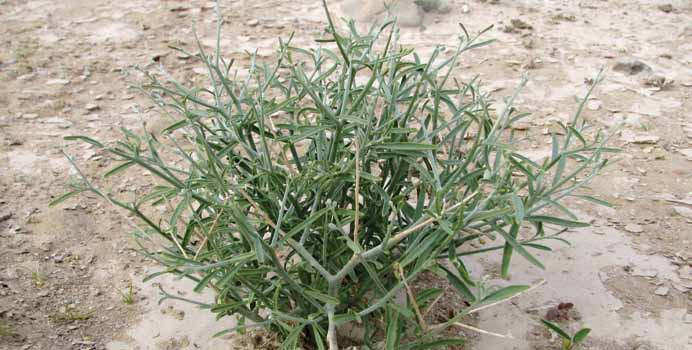
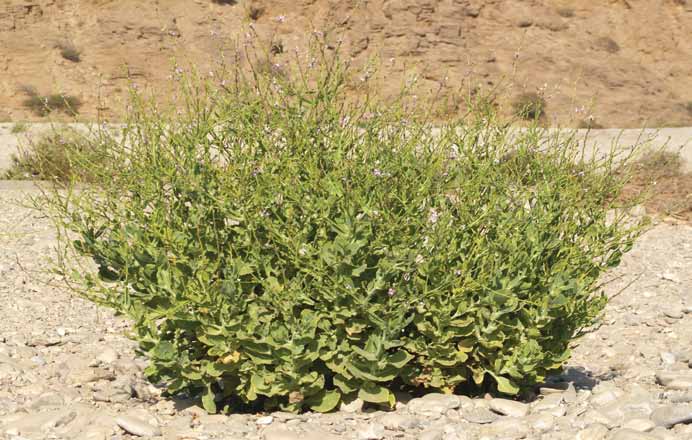
A perennial herb with a woody base, covered in white star-shaped hairs. Stems are prostrate or ascending, 20-30 cm long. Leaves are simple, all on the stems, 5-25 mm long, ovate or elliptic, pointed, entire or nearly so, on stalks of varying length. Flowers are small, axillary or terminal, pale pink (sometimes white), with 4 hairy sepals about 3 mm long and 4 narrow petals about 4 mm long that barely project. The fruit is a slender, somewhat flattened siliqua 8-12 mm long on a thick stalk, straight at first and then strongly curved, covered in stellate hairs, with seeds in one row. Flowers from November to May.
Habitat
Hot deserts: rocky and sandy places and desert wadis, mainly on gravelly wadi banks, also on sand and along roadsides.
Distribution
Native to Israel and the Arabian Peninsula, including Gulf States, Oman, Palestine, Saudi Arabia, Sinai, and Yemen.
Pastoral value
Weak grazing value; a minor pasture plant eaten by livestock.
Other uses
No traditional or economic uses documented.
Sources
- الدليل الحقلي المصور للنباتات البرية في سلطنة عُمان (BOOK.pdf p.70)
- UAE National Red List — Morettia parviflora (habitat, range, grazing as a threat) — nationalredlist.org
- Plants of the World Online — Morettia parviflora Boiss. (native range, seen in search results) — powo.science.kew.org
- R. F. Burton 1879, The Land of Midian Revisited, Appendix 4 (plant list: 'Morettia parviflora, Boiss. Eaten by cattle') — burtoniana.org
- Royal Botanic Garden Edinburgh herbarium — Morettia parviflora, northern Oman (E00125891) — data.rbge.org.uk