Farsetia aegyptia Turra
مشري، جربة، لبنة، البانة
For people
- Eaten by people
- Unknown
- Toxic to people
- Unknown
For livestock
- Grazed by livestock
- Good fodder
- Toxic to livestock
- Not toxic
Edibility and safety notes
No source documents this plant as human food; Egyptian Bedouin use it only as a medicinal decoction. The UAE flora notes that rubbing the plant on the skin causes irritation, so handle with care and do not eat it. It is a valued grazing plant for camels, sheep and goats, and heavy grazing is even listed as a threat to it in the UAE; no livestock poisoning is reported.
This guide is a hobby project, not expert advice. Never eat a wild plant, or feed it to animals, on the strength of this page alone. Read the disclaimer
Description
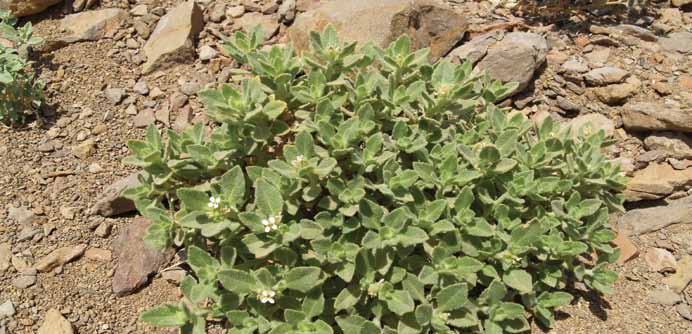
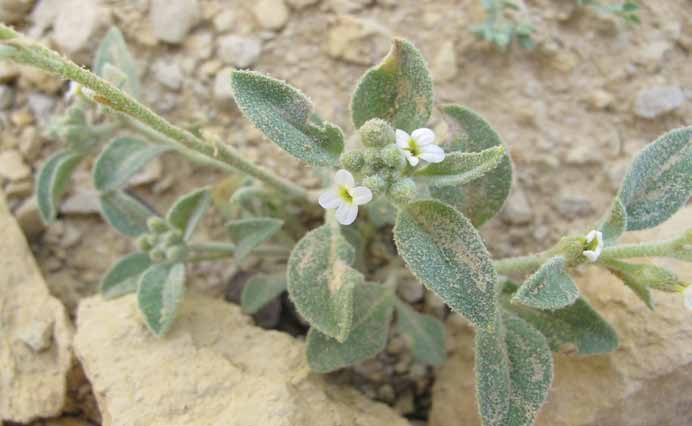
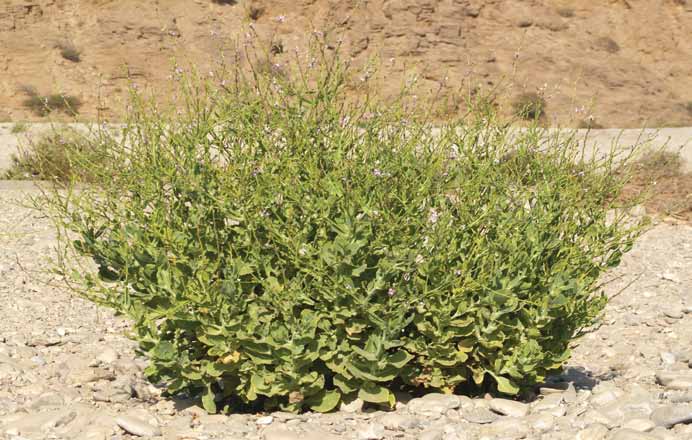
A low, densely branched perennial subshrub with a woody base, usually 20-50 cm tall, with thin whitish-hairy stems. Leaves linear to narrowly lanceolate, alternate, 1-4 cm long, covered with appressed white hairs. Flowers small, with 4 free petals, white to pale pink or purplish, in loose racemes. Fruit an oblong, flattened silique 1.5-2.5 cm long; seeds with a broad membranous wing. Flowers January to April.
Habitat
Grows in desert or dry shrubland biomes.
Distribution
Native from Mauritania to Iraq and northwest India. Found across North Africa, the Middle East, Arabian Peninsula, and South Asia.
Pastoral value
Relished as fodder by camels and other stock. Important browse plant in desert pastoral systems.
Other uses
Used by Bedouins as anti-diabetic and antispasmodic remedy.
Sources
- الدليل الحقلي المصور للنباتات البرية في سلطنة عُمان (BOOK.pdf p.68)
- POWO — Farsetia aegyptia Turra — powo.science.kew.org
- UAE Flora — Farsetia aegyptia (Egyptian Farsetia, جربه) — uaeflora.ae
- UAE National Red List of Vascular Plants — Farsetia aegyptia — nationalredlist.org
- Botanical and genetic characteristics of Farsetia aegyptia Turra growing in Egypt (Bull. Fac. Pharm. Cairo Univ. 2013) — doaj.org