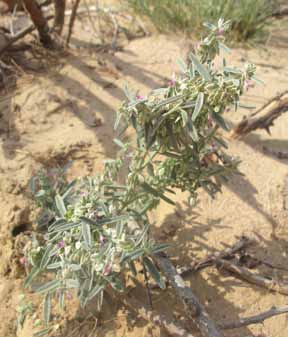
Polygala mascatensis Boiss.
بويل ج ال، غشيش
For people
- Eaten by people
- Unknown
- Toxic to people
- Unknown
For livestock
- Grazed by livestock
- Good fodder
- Toxic to livestock
- Unknown
Edibility and safety notes
No reliable information on human edibility or toxicity of this small spiny shrub was found; it is not known as a food plant and should not be eaten. The Omani field guide records it as good grazing, especially for goats and camels; no independent forage study or poisoning report was found.
This guide is a hobby project, not expert advice. Never eat a wild plant, or feed it to animals, on the strength of this page alone. Read the disclaimer
Description
Small intricately branched shrub up to 40 cm tall, grey-green, with spine-tipped branch ends. Leaves simple, alternate, grey-green, 4-8 x 2-5 mm, broadly ovate to obovate, rounded to notched at the tip, wedge-shaped at the base, entire, downy; petiole very short (about 0.5 mm). Flowers solitary in the leaf axils on pedicels about 1 mm long. Sepals 5, persistent: 3 outer lanceolate sepals about 2 mm long and 2 inner petal-like wings about 2 mm long, yellowish-pink streaked with purple, glabrous. Petals 3, about 2 mm, the middle one boat-shaped with a fringed purple crest. Stamens 8, filaments fused for about half their length into a tube open above. Ovary 2-celled with one ovule per cell; style simple. Capsule 6-7 x 4-5 mm, ovate-oblong, notched at the tip, compressed, glabrous, wingless. Seeds brown, kidney-shaped, compressed, 0.5-1 mm wide. Flowers February-July and September-November.
Habitat
Stony wadis and dry stony slopes of the northern mountains.
Distribution
Near-endemic: native to Oman and the eastern Arabian Peninsula (Gulf States). In Oman recorded mainly from the Hajar mountains and Muscat area. The epithet refers to Muscat.
Pastoral value
Good grazing, especially for goats and camels (Omani field guide).
Other uses
No traditional or economic uses were found in the sources consulted.
Sources
- الدليل الحقلي المصور للنباتات البرية في سلطنة عُمان (BOOK.pdf p.166)
- GBIF — Polygala mascatensis Boiss. (occurrence records in Oman) — gbif.org
- Plants of the World Online — Polygala mascatensis Boiss. — powo.science.kew.org
- Ghazanfar, Novitates from the Sultanate of Oman (Edinburgh Journal of Botany) — Polygala species of Oman — journals.rbge.org.uk