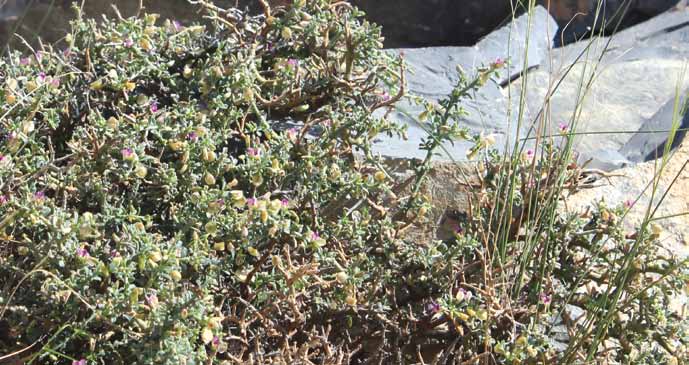
Polygala erioptera DC.
بويل ج ال
For people
- Eaten by people
- Unknown
- Toxic to people
- Unknown
For livestock
- Grazed by livestock
- Good fodder
- Toxic to livestock
- Unknown
Edibility and safety notes
No reliable source was found documenting that people eat this small milkwort, nor any report of poisoning; treat it as not a food plant. The Omani field guide rates it as good grazing, and the genus name reflects an old belief that it increases milk in livestock, but no independent forage study was found. Some related Polygala species have purgative roots, so do not eat it.
This guide is a hobby project, not expert advice. Never eat a wild plant, or feed it to animals, on the strength of this page alone. Read the disclaimer
Description
Annual or short-lived perennial herb, variably hairy, branched near the base, 5-40 cm tall. Leaves linear-filiform to obovate or lanceolate, 2-45 mm long and 1-8 mm wide, obtuse to acute, margins recurved. Racemes lateral, lax, shorter than the leaves, with small greenish-white to mauve or violet flowers. Sepals persistent in fruit, in two whorls: the two inner ones petal-like and wing-shaped, 3-5 x 1.5-3 mm, larger than the three unequal outer sepals. Petals 3, joined below and to the staminal tube; the middle (keel) petal boat-shaped, 2.5-4.5 mm, with a fringed crest. Stamens 8, filaments fused for about half their length into a sheath open above. Ovary 2-celled with one ovule per cell. Capsule elliptic-oblong, notched, 2.5-5 x 1.5-3 mm, hairy. Seeds usually hairy. Flowers throughout the year.
Habitat
Open grasslands, savannahs, and disturbed areas in tropical and subtropical regions.
Distribution
Widespread in tropical Africa, the Arabian Peninsula (Oman, UAE, Qatar, eastern Saudi Arabia) and tropical Asia from Pakistan and India to Indo-China. In Oman recorded from the north (Muscat, Ad Dakhiliyah) and Dhofar.
Pastoral value
Good grazing according to the Omani field guide. The genus name Polygala reflects an old belief that these plants increase milk yield in livestock; no independent forage data were found.
Other uses
Used in traditional medicine in various African and Asian cultures.
Sources
- الدليل الحقلي المصور للنباتات البرية في سلطنة عُمان (BOOK.pdf p.165)
- Flora of Pakistan (eFloras) — Polygala erioptera — efloras.org
- UAE National Red List of Vascular Plants — Polygala erioptera — nationalredlist.org
- Flora of Qatar — Polygala erioptera — floraofqatar.com
- eNature Qatar — Woolly-winged milkwort — enature.qa
- GBIF — Polygala erioptera DC. (occurrence records in Oman) — gbif.org