Aerva javanica (Burm.f.) Juss. ex Schult.
را، تومي، الراء، راع، أفهى، رى، الأراء، الراع
For people
- Eaten by people
- Not edible
- Toxic to people
- Unknown
For livestock
- Grazed by livestock
- Limited fodder
- Toxic to livestock
- Not toxic
Edibility and safety notes
Not a food plant: no edible use for people is known. It is used for stuffing pillows and saddles and in folk medicine. No poisoning is reported, but its safety when swallowed has not been established. Sheep and goats graze it; camels and cattle mostly ignore it or take it only when nothing better is available, and it is fibrous and low in protein.
This guide is a hobby project, not expert advice. Never eat a wild plant, or feed it to animals, on the strength of this page alone. Read the disclaimer
Description
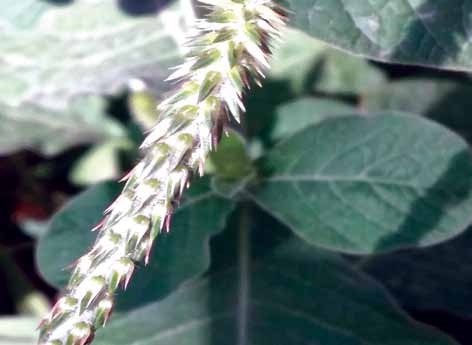
A much-branched perennial herb or subshrub with a woody base, usually 30-60 cm tall but able to reach about 1.5 m, covered in dense white woolly hairs. Leaves are simple, alternate and entire, obovate to spoon-shaped, 10-50 mm long and 8-15 mm wide. The plant is dioecious; the small silvery-white flowers (about 3 mm) are crowded in woolly spikes in the leaf axils and at the branch tips. The fruit is a tiny one-seeded utricle enclosed in the perianth. Flowers from December to June.
Habitat
Hot deserts: roadsides, wadis, stony ground and hill slopes, mostly on sandy or gravelly soils.
Distribution
Dry tropical and subtropical regions of the Old World: much of Africa (including Madagascar), the Arabian Peninsula and south-west and south Asia; widespread in Oman. Naturalised in northern Australia.
Pastoral value
The field guide classes it as not a grazing plant. Elsewhere it is grazed by sheep and goats, while camels and cattle mostly ignore it or eat it only when better forage is lacking; it is high in fibre and low in protein.
Other uses
The woolly flower heads are traditionally used to stuff cushions, pillows and saddle pads. In folk medicine the dried, powdered plant is traditionally applied to sores and wounds, and the roots are used as toothbrushes. Also used as a soil binder in desert reclamation and as fuel.
Sources
- الدليل الحقلي المصور للنباتات البرية في سلطنة عُمان (BOOK.pdf p.24)
- Feedipedia - Kapok bush (Aerva javanica) — feedipedia.org
- Useful Tropical Plants - Aerva javanica — tropical.theferns.info
- Wikipedia - Aerva javanica — en.wikipedia.org
- Flora of Qatar - Aerva javanica — floraofqatar.com