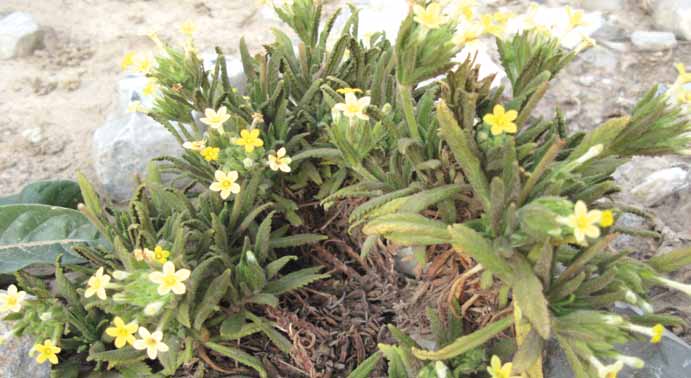
Anagallis arvensis L.
عوينة، عين القطوة، عين القط، عين الجمل، عوينة الحية، عين الفطوس
For people
- Eaten by people
- Not edible
- Toxic to people
- Toxic
For livestock
- Grazed by livestock
- Not grazed
- Toxic to livestock
- Toxic
Edibility and safety notes
Do not eat and do not use as a home remedy. The whole plant contains toxic saponins and other harmful compounds; experimental doses caused nausea, headache and pain in people, and handling the leaves gives some people a skin rash. Livestock normally avoid it because it is bitter, but sheep and cattle forced to graze it when little else is available have died of kidney failure and gut inflammation; it is also poisonous to horses, dogs, rabbits and poultry, and it stays toxic when dried.
This guide is a hobby project, not expert advice. Never eat a wild plant, or feed it to animals, on the strength of this page alone. Read the disclaimer
Description
A small, hairless annual with weak, sprawling to ascending stems that are square in cross-section and 5-30 cm long. The leaves are opposite, stalkless, oval and bright green. The flowers are borne singly on slender stalks in the leaf axils; they are flat and five-lobed, 10-15 mm across, scarlet-orange or blue (blue is the form recorded in the Gulf), and open only in sunshine, closing in dull weather. The fruit is a small globular capsule containing many seeds.
Habitat
Alluvial soils on irrigated land, around wet places and at the edges of cultivated fields; also gardens, farms, roadsides and other disturbed ground.
Distribution
Native to Europe, North Africa and western Asia and now naturalised almost worldwide; in Oman it occurs in parts of the north.
Pastoral value
Not a grazing plant. Livestock usually avoid it because it is bitter; it is poisonous to sheep, cattle and horses when eaten in quantity.
Other uses
Historically used in folk medicine as a diuretic and expectorant, for rheumatism, liver and kidney complaints, dropsy, snake-bite, leprosy, epilepsy and mental disorders, and applied to slow-healing wounds. Internal use is no longer recommended because the plant contains toxic saponins. The flowers close in dull weather, which gave the plant its reputation as a 'poor man's weather-glass'.
Sources
- الدليل الحقلي المصور للنباتات البرية في سلطنة عُمان (BOOK.pdf p.171)
- Flock and Herd (NSW district veterinarians) - suspected Anagallis arvensis poisoning in sheep, with literature review — flockandherd.net.au
- Plants For A Future - Anagallis arvensis — pfaf.org
- Wikipedia - Lysimachia arvensis — en.wikipedia.org
- Flora of Qatar - Anagallis arvensis — floraofqatar.com
- HorseDVM - Scarlet pimpernel toxicity — horsedvm.com