Atriplex farinosa Forssk.
عفار، عفر
For people
- Eaten by people
- Unknown
- Toxic to people
- Unknown
For livestock
- Grazed by livestock
- Good fodder
- Toxic to livestock
- Unknown
Edibility and safety notes
No reliable information was found on people eating this coastal saltbush or on its toxicity, so it should not be eaten. The field guide rates it as good grazing; no independent source on its use by livestock was found, although related saltbushes (Atriplex) are well-known salt grazing for camels and sheep.
This guide is a hobby project, not expert advice. Never eat a wild plant, or feed it to animals, on the strength of this page alone. Read the disclaimer
Description
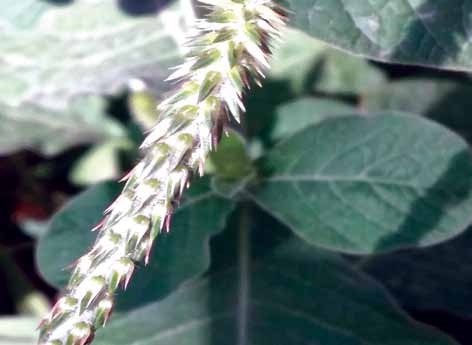
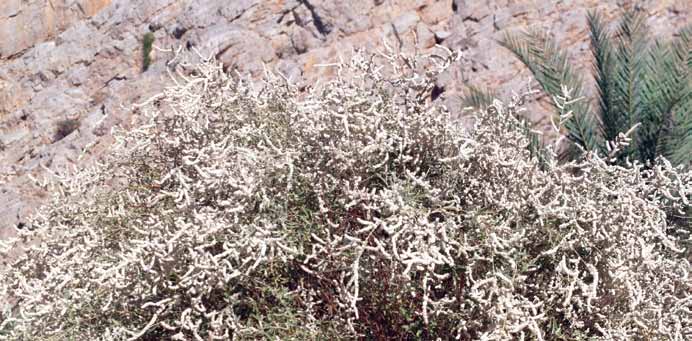
A shrub or woody herb 1-2 m high with usually erect, fairly robust stems. All parts covered with very dense mealy white to pale grey-green indumentum. Leaves are alternate, mostly ovate-oblong, 2-6 cm long, with cordate base. Flowers in sessile clusters densely crowded into terminal paniculate spikes.
Habitat
Sandy shores and the edge of the sea, at sea level; tolerant of salt.
Distribution
North-east tropical Africa (Egypt and Sinai, Sudan, Eritrea, Djibouti, Somalia, Kenya), Saudi Arabia, Yemen, Socotra, the Gulf states and Oman.
Pastoral value
Rated as good grazing in the field guide.
Other uses
No documented uses found.
Sources
- الدليل الحقلي المصور للنباتات البرية في سلطنة عُمان (BOOK.pdf p.75)
- Plants of the World Online — Atriplex farinosa Forssk. — powo.science.kew.org
- Plants of the World Online — Atriplex farinosa subsp. farinosa — powo.science.kew.org
- Qatar e-Nature — Orache (Atriplex leucoclada, related species: salt grazing for sheep and camels) — enature.qa
- Journal of Agricultural and Marine Sciences (1999) — nutritive value of Atriplex leaves in Saudi Arabia (related species) — doaj.org