Calligonum comosum L'Hér.
أرطى، أرطا، عبل
For people
- Eaten by people
- Edible
- Toxic to people
- Unknown
For livestock
- Grazed by livestock
- Good fodder
- Toxic to livestock
- Unknown
Edibility and safety notes
People eat the flowers fresh and the tart young fruits, which freshen the mouth, and pounded young twigs are traditionally added to milk as a flavouring; these are nibbles and flavourings rather than a staple. No poisoning is reported, but no source positively confirms that large amounts are safe, and the plant is rich in tannins (it was used for tanning hides), so eat only small quantities. It is a good forage shrub, browsed especially by camels and also by goats and sheep, with no harm reported.
This guide is a hobby project, not expert advice. Never eat a wild plant, or feed it to animals, on the strength of this page alone. Read the disclaimer
Description
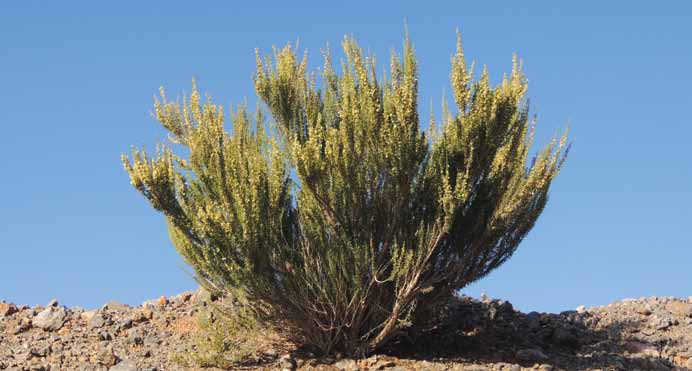
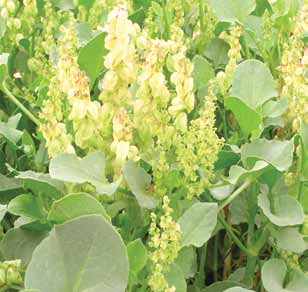
A woody-based ascending shrub, much branched and erect, growing up to 250 cm high. Older branches are rigid with whitish grey bark, younger shoots are green and flexible. Leaves are minute and soon deciduous. Flowers about 0.5 cm across with white-pink perianth and bright-red anthers. Fruit capsule is red or greenish-yellow with longitudinal wings.
Habitat
Frequent to common in deeper sand, dunes, plains and valleys. Tolerates saline conditions. Cultivated around desert plantations as windbreaks.
Distribution
Native to the Sahara, Socotra, the Arabian Peninsula, the Middle East extending to Pakistan and the Rajasthan desert in western India.
Pastoral value
Major food source for camels and also browsed by sheep and goats. Important forage plant in desert pastoral systems.
Other uses
Sand dune stabilizer and indicator of fresh water. Used for smokeless firewood and tanning. Young twigs are edible and added to milk or rice. Used medicinally for ophthalmic and stomach problems. Dried leaves used for toothache. Used for hair scenting and dyeing. Flowers and fruits are edible.
Sources
- الدليل الحقلي المصور للنباتات البرية في سلطنة عُمان (BOOK.pdf p.167)
- Qatar e-Nature — Arta (Calligonum comosum): fruits edible, twigs added to milk, tanning — enature.qa
- Wikipedia — Calligonum comosum (flowers eaten fresh; forage for livestock) — en.wikipedia.org
- GBIF backbone — Calligonum comosum L'Hér. — api.gbif.org
- Wikipedia — Calligonum (accepted species list) — en.wikipedia.org
- Wikipedia — Calligonum polygonoides (closely related; flowers eaten, fed to cattle) — en.wikipedia.org
- Department of Health Abu Dhabi medicinal plants leaflet - Calligonum comosum — medicinalplants.doh.gov.ae
- Useful Temperate Plants - Calligonum comosum — temperate.theferns.info