
Calotropis procera (Aiton) Dryand
شخر، عشر، عشار، أشخر, الأشخر
For people
- Eaten by people
- Not edible
- Toxic to people
- Toxic
For livestock
- Grazed by livestock
- Limited fodder
- Toxic to livestock
- Toxic
Edibility and safety notes
Not a food plant: all parts, especially the white latex, contain cardiac glycosides (calotropin and related cardenolides) and the latex has been used as an arrow poison. The latex is a strong skin and eye irritant and can cause blindness if it gets in the eyes; keep away from children. Livestock generally avoid it; sheep, goats and camels browse leaves and flowers only in times of scarcity, deaths of sheep and goats have been recorded in Sudan, and fresh leaves are more dangerous than dried material.
This guide is a hobby project, not expert advice. Never eat a wild plant, or feed it to animals, on the strength of this page alone. Read the disclaimer
Description
A large evergreen shrub or small tree 2-6 m tall whose stems and leaves exude a white milky latex. Young branches are white and woolly to almost hairless. Leaves are simple, opposite, almost sessile, broadly ovate to obovate, somewhat fleshy, 10-30 cm long and 5-15 cm wide, grey-green with a waxy appearance. Flowers are in axillary cymes, about 20 mm across, with five spreading lobes that are whitish in the centre and dark purple at the tips, with a fleshy corona. Fruit is a pair (sometimes one) of inflated, smooth, green follicles 8-12 cm long containing many flattened seeds with silky hairs. Flowers from May to November.
Habitat
Found from sea level up to 1300 m altitude in semi-arid conditions (150-1000 mm annual rainfall) on sandy soils.
Distribution
Native to Africa, Madagascar, Arabian Peninsula, Southern Asia and Indochina. Widely naturalized in Australia, Pacific Islands, Central and South America, and the Caribbean.
Pastoral value
Not a grazing plant: the bitter, toxic latex makes livestock avoid it. Sheep, goats and camels may browse leaves, flowers and young pods only in times of extreme scarcity; dried material is safer than fresh leaves, and deaths of sheep and goats have been recorded.
Other uses
Traditionally used in Oman and across North Africa, the Middle East and South Asia: leaves are buried near date palms against root-boring insects; warmed leaves are applied to bruises, sprains and painful joints; the latex is applied to camel mange and used in folk medicine for skin diseases, leprosy, fevers and worms. The latex and root bark have been used as arrow poison in India, and the ash was mixed with sulphur for gunpowder. Stems yield a strong fibre for ropes, nets and paper, the seed floss is used for stuffing, and the wood makes charcoal.
Sources
- الدليل الحقلي المصور للنباتات البرية في سلطنة عُمان (BOOK.pdf p.28)
- Feedipedia — Calotropis (Calotropis procera) — feedipedia.org
- Plants For A Future — Calotropis procera — pfaf.org
- Flora of Qatar — Calotropis procera — floraofqatar.com
- World Agroforestry — Calotropis procera (Agroforestree Database) — apps.worldagroforestry.org
From the same family
All in this family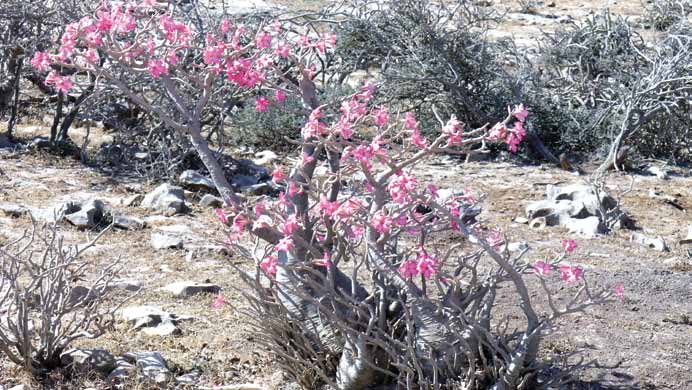
Apocynaceae
Desert rose, Impala lily, Sabi star, Mock azalea
Adenium obesum (Forssk.) Roem. & Schult.
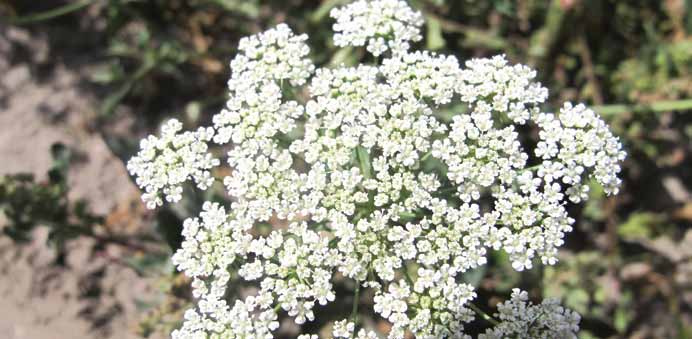
Apiaceae
Bishop's weed, False Queen Anne's lace, Greater ammi, Bishop's flower
Ammi majus L.
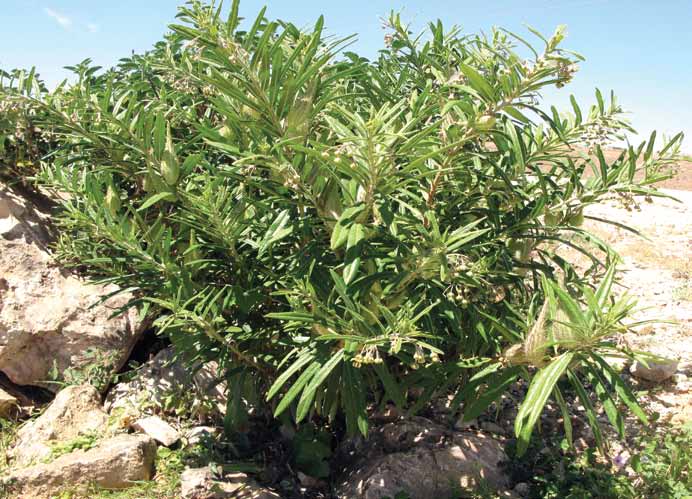
Apocynaceae
Milkweed, Narrow-leaved cotton bush, Balloon cotton bush, Swan plant
Gomphocarpus fruticosus (L.) W.T.Aiton
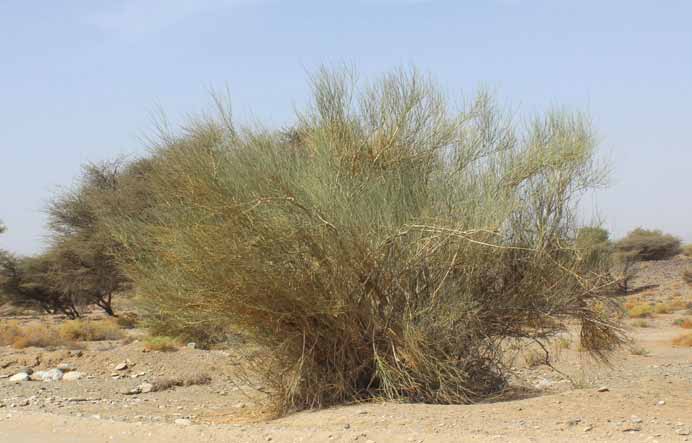
Apocynaceae
Broom Bush, Khimp, Khip, Marakh
Leptadenia pyrotechnica (Forssk.) Decne.