Rumex vesicarius L.
الحماض، حميضا ، ضرس العجوز، سوريل
For people
- Eaten by people
- Edible
- Toxic to people
- Unknown
For livestock
- Grazed by livestock
- Unknown
- Toxic to livestock
- Unknown
Edibility and safety notes
The sour leaves are eaten by people, raw in salads like sorrel or cooked like spinach. They contain quite high levels of oxalic acid, so eat only moderate amounts; cooking lowers the oxalate content, and people prone to kidney stones, gout, arthritis, rheumatism or stomach hyperacidity should be especially cautious. The Omani book lists it as a grazing plant, but its forage value could not be confirmed from other sources; no report of livestock poisoning by this species was found, although oxalate-rich docks can harm animals that eat large amounts.
This guide is a hobby project, not expert advice. Never eat a wild plant, or feed it to animals, on the strength of this page alone. Read the disclaimer
Description
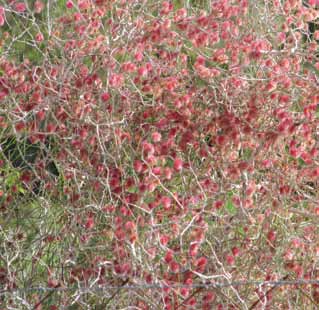
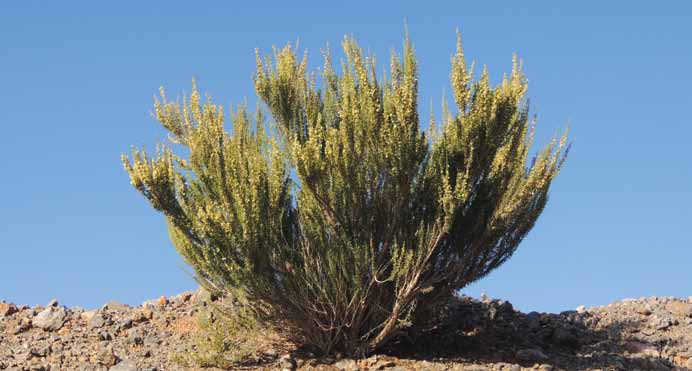
An erect succulent annual herb growing to about 60 cm tall with triangular to ovate leaves, truncate or cordate at the base, 5-10 cm long with entire margins. Flowers are green with red tinge, six perianth segments with inner three becoming enlarged and papery (bladder-like) when fruiting.
Habitat
Sandy alluvial soils, heavy clay, and gravelly well-draining soils. Found along roadsides and in disturbed areas in arid and semi-arid environments.
Distribution
Saharo-Arabian, extending into the Mediterranean and Sudanian regions: North Africa from Morocco and Mauritania to Egypt, Sudan and Somalia, then through Arabia and Iran to Afghanistan and India. Naturalised in Australia. In Oman it occurs in the north.
Pastoral value
Grazed by livestock. The leaves are rich in oxalic acid, which can be harmful to animals if eaten in large quantities.
Other uses
The sour leaves are eaten raw in salads or cooked as a vegetable, in the same way as sorrel. In traditional medicine the leaves are regarded as laxative, diuretic, astringent and cooling, and the roasted seeds are traditionally used for dysentery.
Sources
- الدليل الحقلي المصور للنباتات البرية في سلطنة عُمان (BOOK.pdf p.169)
- Plants For A Future — Rumex vesicarius — pfaf.org
- Useful Tropical Plants — Rumex vesicarius — tropical.theferns.info
- Flora of Qatar — Rumex vesicarius — floraofqatar.com
- Wikipedia — Rumex vesicarius — en.wikipedia.org
- GBIF occurrences in Oman — Rumex vesicarius — api.gbif.org
- Rumex Species: Phytochemistry, Pharmacology and Nutritional Potential (Food Sci Nutr 2025) — pmc.ncbi.nlm.nih.gov
- Texas A&M Rangeland plants – Dock — rangeplants.tamu.edu