Chrozophora oblongifolia (Del.) A. Juss.
المشرية، تنوم، تنب، تنومة
For people
- Eaten by people
- Not edible
- Toxic to people
- Unknown
For livestock
- Grazed by livestock
- Not grazed
- Toxic to livestock
- Unknown
Edibility and safety notes
Not a food plant: no food use is recorded, and the whole plant is used in folk medicine as a strong laxative and to induce vomiting, so it should not be eaten. The Omani field guide says livestock do not graze it. Its toxicity has not been established, but caution is warranted: rats fed a diet containing Chrozophora leaves developed gut, liver and kidney lesions, and the related Chrozophora plicata killed goats and sheep in feeding trials.
This guide is a hobby project, not expert advice. Never eat a wild plant, or feed it to animals, on the strength of this page alone. Read the disclaimer
Description
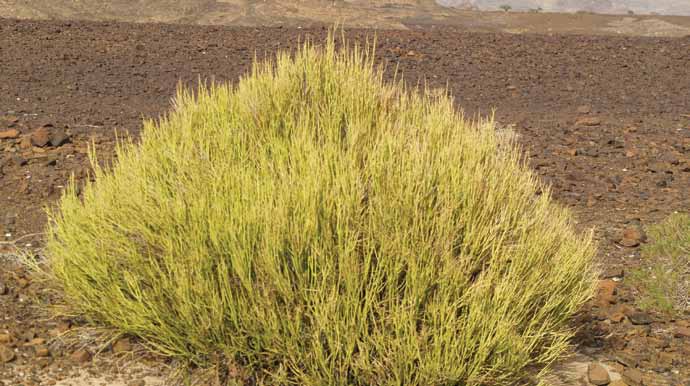
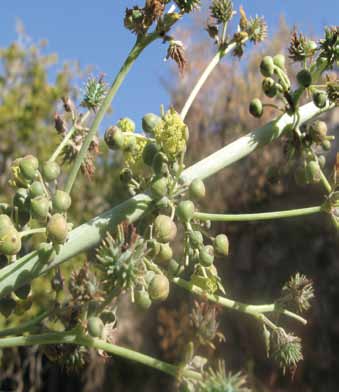
An erect shrublet or woody herb up to about 1 m tall (often 30-50 cm), stout and woody below, covered with star-shaped hairs. Leaves are simple, alternate, stalked (petiole 0.5-3.5 cm), triangular-ovate to triangular-lanceolate or oblong, about 4-7 x 1.5-3 cm, with 3-5 veins from the base, hairy on both surfaces. Flowers are unisexual: male flowers almost stalkless with yellowish petals; female flowers on stalks that lengthen and bend downward in fruit, with a silvery ovary. The fruit is a rounded, three-lobed capsule about 5-6 x 7-9 mm, bluish-purple and slightly rough; seeds are triangular-ovoid, 4-5 x 3-4 mm, warty, yellowish-grey.
Habitat
Wadis and sandy terraces; sandy loam and gravelly sand in arid regions.
Distribution
Native from Sinai to northeast tropical Africa, Syria to the Arabian Peninsula, and Pakistan to northwest India. Found in Oman, Saudi Arabia, Yemen, Djibouti, Eritrea, Ethiopia, Somalia and Sudan.
Pastoral value
Not a grazing plant according to the Omani field guide. Related Chrozophora species are avoided by most livestock and have proved poisonous to goats and sheep.
Other uses
Traditionally, the whole plant is used in folk medicine as a strong laxative and emetic; the seeds are used for diarrhoea, and the juice of the immature fruits is applied to burns, blisters, ulcers and anal fissures. In Sudan stem or leaf extracts have been used for gonorrhoea. Related Chrozophora species yield dyes.
Sources
- الدليل الحقلي المصور للنباتات البرية في سلطنة عُمان (BOOK.pdf p.97)
- Encyclopedia of Medicinal Plants of UAE - Chrozophora oblongifolia — medicinalplants.doh.gov.ae
- PROTA - Chrozophora plicata (with section on Chrozophora oblongifolia; livestock toxicity of the genus) — plantuse.plantnet.org(PROTA)