Cleome austroarabica D.F.Chamb. & Lamond
مقيبيلة الشمس
For people
- Eaten by people
- Unknown
- Toxic to people
- Unknown
For livestock
- Grazed by livestock
- Not grazed
- Toxic to livestock
- Unknown
Edibility and safety notes
No reliable information was found on whether people can eat this plant or whether it is poisonous, so it should not be eaten. It is a sticky, glandular dwarf shrub, and the Omani field guide records it as not grazed by livestock. No source was found on toxicity to animals.
This guide is a hobby project, not expert advice. Never eat a wild plant, or feed it to animals, on the strength of this page alone. Read the disclaimer
Description
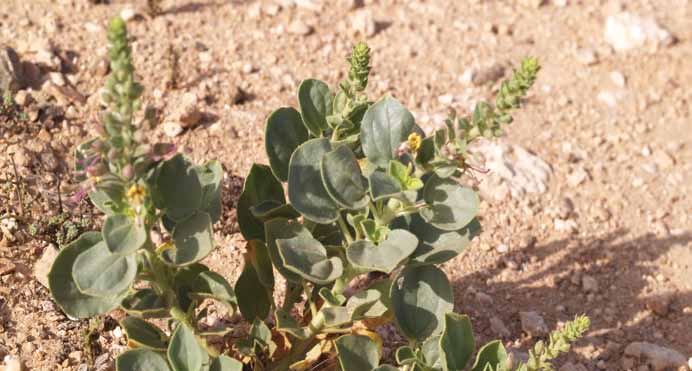
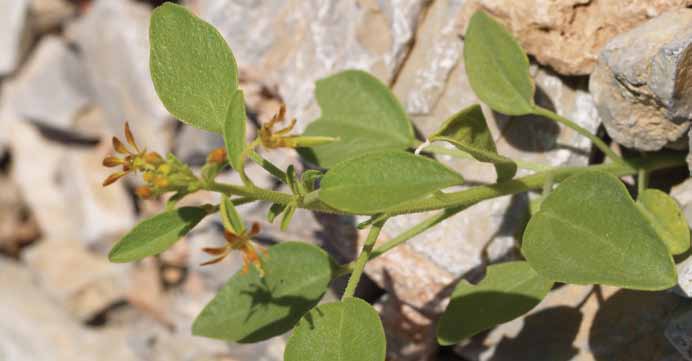
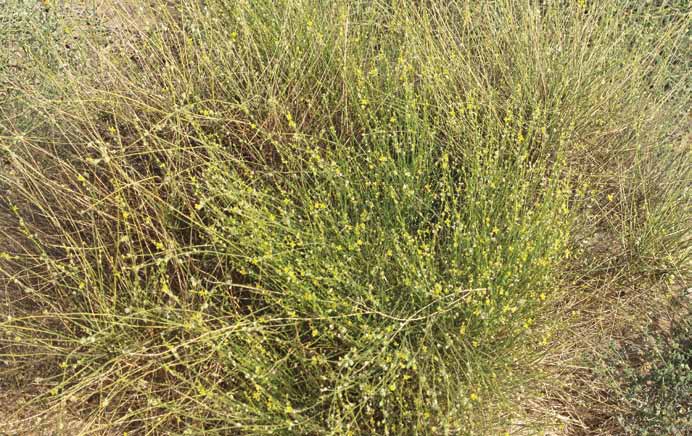
A much-branched dwarf shrub, 15-100 cm tall, densely covered with sticky stalked glands. Leaves simple, broadly ovate to orbicular, 5-20 mm long and 5-15 mm wide, on petioles 7-20 mm long. Inflorescence terminal, loose and few-flowered, with leaf-like bracts. Sepals lanceolate, 3-5 mm. Petals four, yellow with red lines, 5-8 mm long. Stamens four. Fruit an erect, elliptic capsule 12-18 mm long with very small seeds. Two subspecies occur in Oman: subsp. austroarabica in Dhofar and subsp. muscatensis in the north.
Habitat
Rocky slopes and gravelly or rocky wadi beds, from sea level to about 600 m in Dhofar and up to 1750 m on limestone and gabbro in northern Oman.
Distribution
Endemic to southern and eastern Arabia: Dhofar and northern Oman, southern Yemen, the Socotra archipelago (Abd al Kuri), the United Arab Emirates and one outlying station in Saudi Arabia.
Pastoral value
Not grazed, according to the Omani field guide.
Other uses
No documented uses were found.
Sources
- الدليل الحقلي المصور للنباتات البرية في سلطنة عُمان (BOOK.pdf p.63)
- Chamberlain, Clement & Lamond (1994), Studies in the Flora of Arabia XXVIII, Edinburgh J. Bot. 51: 49-58 (original description) — journals.rbge.org.uk
- IPNI — Cleome austroarabica D.F.Chamb. & J.Lamond — ipni.org
- IPNI — Cleome austroarabica subsp. muscatensis — ipni.org
- eFlora of India — Cleome austroarabica (Oman, Yiti Beach photos) — efloraofindia.com