Dyschoriste dalyi A.G.Mill.
ضفيد
For people
- Eaten by people
- Unknown
- Toxic to people
- Unknown
For livestock
- Grazed by livestock
- Good fodder
- Toxic to livestock
- Unknown
Edibility and safety notes
No reliable information on edibility or toxicity for people was found; no food use is documented. The field guide describes it as good grazing for cattle and goats in Dhofar; no other source on its forage value or on any hazard to livestock was found.
This guide is a hobby project, not expert advice. Never eat a wild plant, or feed it to animals, on the strength of this page alone. Read the disclaimer
Description
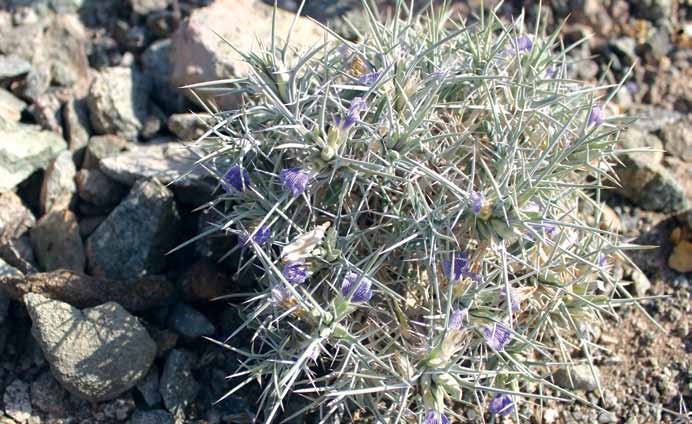
A perennial herb or small subshrub that creeps along the ground, reaching 60 cm in length and rooting at the nodes. Leaves are opposite, with wavy margins. Flowers are mostly solitary or paired in the leaf axils, pink to pale lilac, with purple markings on the lower lobes. The fruit is an oblong, pale brown capsule with many brown seeds covered in white hairs. Flowers from August to November.
Habitat
Common in Dhofar in the moist woodlands, up to about 1250 m; the type was collected in a dry rocky wadi with Anogeissus and Commiphora scrub.
Distribution
Endemic to the southern Arabian Peninsula, found in Oman and Yemen.
Pastoral value
Good grazing for cattle and goats.
Other uses
Of scientific interest as an endemic species. Limited documented uses.
Sources
- الدليل الحقلي المصور للنباتات البرية في سلطنة عُمان (BOOK.pdf p.18)
- Royal Botanic Garden Edinburgh herbarium - holotype E00273441 (Dyschoriste dalyi) — data.rbge.org.uk
- Rock Garden Plants database (kadel.cz) - Dyschoriste dalyi — flora.kadel.cz
- Trefle - Dyschoriste dalyi — trefle.io
- Wikipedia - Dyschoriste — en.wikipedia.org