Blepharis ciliaris (L.) B.L. Burtt
كنب، شوك الضب
For people
- Eaten by people
- Unknown
- Toxic to people
- Unknown
For livestock
- Grazed by livestock
- Limited fodder
- Toxic to livestock
- Not toxic
Edibility and safety notes
Not known as a food plant; no source documents people eating it, although its seeds and roots are used in traditional medicine (ground root as kohl for eye complaints, seeds for inflammation). Do not use it as food or home remedy on that basis. Grazing value is low: camels browse it, while sheep and goats generally do not eat this spiny herb. No toxicity to livestock is reported.
This guide is a hobby project, not expert advice. Never eat a wild plant, or feed it to animals, on the strength of this page alone. Read the disclaimer
Description
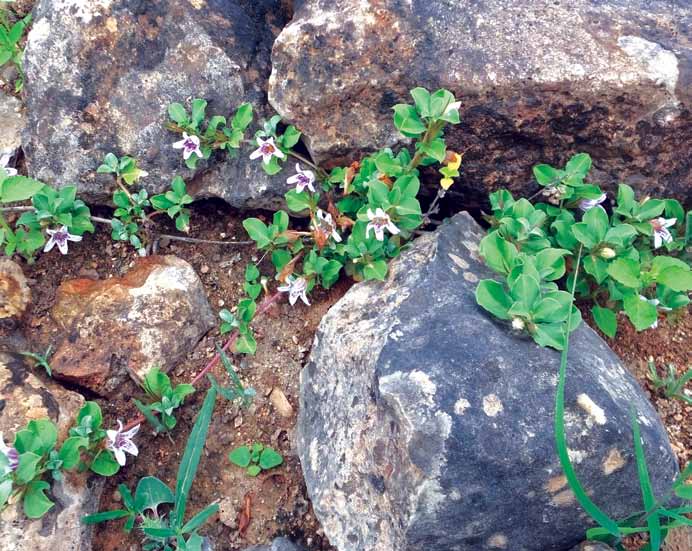
A perennial (sometimes short-lived) herb 20-40 cm tall, covered with short grey hairs or almost hairless, much branched from the base with stiff stems. Stem leaves oblong to lanceolate, 2-6 x 0.8-2 cm, narrowed into a petiole about 1 cm long, entire or with slender spines along the margin, appearing in whorls of four and soon falling. Flowers in dense spikes, each subtended by a flat, ovate, 5-nerved bract 3-5 cm long that ends in a spine and bears 3-5 pairs of lateral spines, plus several smaller bracteoles. Calyx dry, papery, hairy, persistent, with 4 unequal lobes. Corolla with a very short tube splitting into a single three-lobed lip 20-28 mm long, blue-purple with dark veins, fading to white. Stamens 4 with thick filaments. Fruit an elliptic, compressed, hairless capsule 6-7 mm long with two seeds covered in coiled hairs that become mucilaginous when wet. Flowers May to December.
Habitat
Semi-desert species found in dry sandy areas and disturbed habitats such as roadsides. Grows in desert or dry shrubland biomes.
Distribution
Found in Egypt, Iran, Jordan, Oman, Pakistan and Sudan. Widely distributed in most North African countries and the Arabian Peninsula.
Pastoral value
Low grazing value; browsed by camels, but sheep and goats generally avoid it.
Other uses
Used in traditional medicine to treat fever, malaria, diarrhea, skin diseases, and headaches. Roots and leaves boiled to make tea for stomach pains. Also used as an ornamental plant.
Sources
- الدليل الحقلي المصور للنباتات البرية في سلطنة عُمان (BOOK.pdf p.16)
- GBIF backbone — Blepharis ciliaris (L.) B.L.Burtt — api.gbif.org
- Flora of Qatar — Blepharis ciliaris — floraofqatar.com
- Qatar e-Nature — Eyelash plant (Blepharis ciliaris) — enature.qa