Fagonia indica Burm.f.
جربة، شكاعى، شويكة، المشكاع
For people
- Eaten by people
- Unknown
- Toxic to people
- Unknown
For livestock
- Grazed by livestock
- Limited fodder
- Toxic to livestock
- Not toxic
Edibility and safety notes
No reliable source documents this plant as human food; it is used in folk medicine (bitter decoctions and 'Fagonia tea' in Pakistan and the Gulf) but that is not a food use. No poisoning of people has been reported, yet safety data are limited, so do not eat it. The spiny, bitter shrublet is of low grazing value; camels and other animals browse it without reported harm.
This guide is a hobby project, not expert advice. Never eat a wild plant, or feed it to animals, on the strength of this page alone. Read the disclaimer
Description
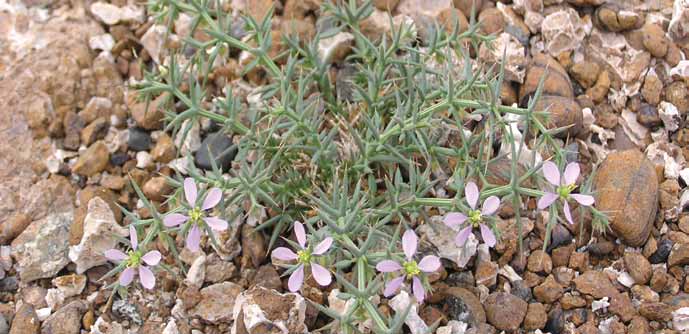
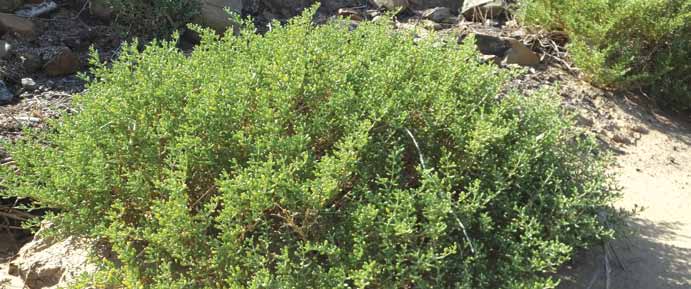
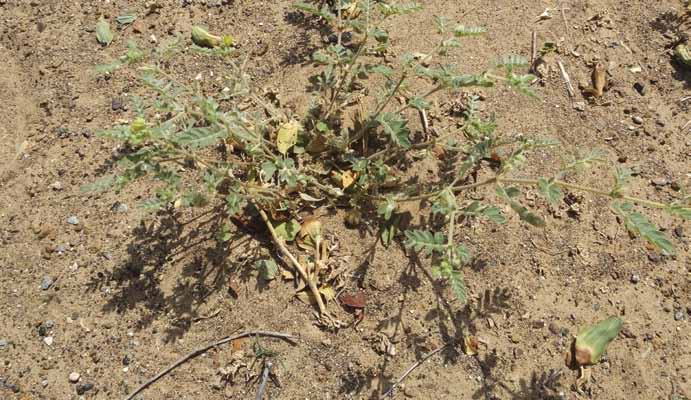
A spiny, woody perennial herb up to 80 cm tall. Branches cylindrical, striate, glandular or waxy, with internodes 2-4 cm long. Leaves opposite, trifoliolate, with the stipules modified into spines 0.8-2.5 cm long; leaflets sessile or shortly stalked, linear-elliptic to lanceolate. Flowers solitary in the leaf axils on stalks about 6 mm long emerging between the spiny stipules, fragrant, about 1.2 cm across, purple-pink (occasionally white). Sepals 5, lanceolate, persistent; petals 5, ovate, clawed, overlapping in bud; stamens 10; ovary sessile with 5 carpels, 5-celled and 5-angled, with 2 ovules per cell; style persistent, stigma simple. Fruit a pyramidal, 5-angled capsule 3-5 mm wide, bent backwards, splitting along the axis into 5 one-seeded parts. Seeds compressed, ovate, with a mucilaginous coat. Flowers during most of the year.
Habitat
Sandy and gravelly plains, sandy depressions, hillsides and mountains up to 2000 m, and roadsides.
Distribution
North Africa and the Sahel east through Egypt, Sinai and the Arabian Peninsula (Kuwait, Qatar, Bahrain, UAE, Saudi Arabia, Yemen, Oman) to Iran, Afghanistan, Pakistan and India.
Pastoral value
Of low grazing value; browsed by camels.
Other uses
Traditionally used in Oman for headache (the plant is ground to a paste and applied to the head); the juice of the cooked plant is drunk for spleen and stomach pains; leaves and roots are soaked in water and the infusion drunk for intestinal blockage and genital ailments, and as an appetiser before meals. For jaundice, powdered branches and leaves are sprinkled on roasted livestock liver that is then eaten, or over food. In the wider region it is used as a bitter tonic decoction ("Fagonia tea") for fever, stomach and skin complaints.
Sources
- كتاب نباتات عمان
- POWO — Zygophyllum indicum (Burm.f.) Christenh. & Byng (accepted name of Fagonia indica) — powo.science.kew.org
- Encyclopedia of Medicinal Plants of UAE (Dept. of Health Abu Dhabi) — Fagonia indica — medicinalplants.doh.gov.ae
- Flora of Qatar — Fagonia indica — floraofqatar.com
- Burton, The Land of Midian Revisited (1879), appendix IV: Fagonia spp. 'animals eat' — burtoniana.org