Hammada salicornica (Moq.) Iljin
الرمث
For people
- Eaten by people
- Unknown
- Toxic to people
- Unknown
For livestock
- Grazed by livestock
- Limited fodder
- Toxic to livestock
- Not toxic
Edibility and safety notes
No reliable source documents this salty, leafless desert shrub as human food, and no information on its safety for people was found, so it should not be eaten. It is a good and important grazing plant for camels, especially when annuals and grasses are lacking; other livestock eat it only when little else is available. No livestock poisoning is reported, but regional sources warn that feeding heavily on saltbushes alone is physically harmful to animals.
This guide is a hobby project, not expert advice. Never eat a wild plant, or feed it to animals, on the strength of this page alone. Read the disclaimer
Description
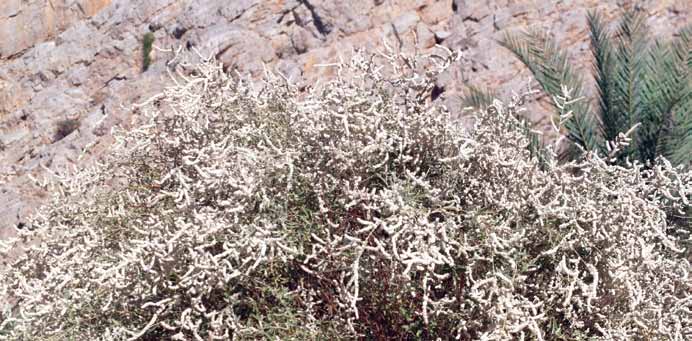
A shrub 30-60 cm tall whose woody lower stems irregularly produce new shoots each year. Branches jointed, ascending, stiff, pale to ivory-coloured, turning waxy yellow when dry. Leaves reduced to small triangular scales joined into a short cup with a membranous edge, woolly inside. Flowers in short, scattered spikes 3-6 cm long, mostly at the ends of the current year's green main or side shoots. Flowers bisexual, each with two persistent bracteoles that are woolly beneath; perianth of 5 segments; stamens 5, free, alternating with 5 small staminodes; ovary superior with two short styles. Fruit 7-8 mm across including the wings; wings obovate to rounded, directed upwards, strongly overlapping, unequal, pale brownish. Seeds horizontal. Flowers from September to November.
Habitat
Sandy ground, sandstone and granite in hot deserts.
Distribution
Egypt and south-west Asia: the Arabian Peninsula (including Kuwait, Bahrain, Qatar, eastern Saudi Arabia, the UAE and northern Oman), Iran, Afghanistan and Pakistan.
Pastoral value
Good grazing for camels; other livestock eat it mainly when little else is available.
Other uses
Used as firewood. Regional sources record only a few folk-medicinal uses of the stems.
Sources
- كتاب نباتات عمان
- Qatar e-Nature — Rimth (Haloxylon salicornicum): good fodder for camels; Mandaville's caution on saltbush grazing — enature.qa
- POWO — Haloxylon salicornicum (Moq.) Bunge ex Boiss. — powo.science.kew.org
- POWO — Hammada salicornica (Moq.) Iljin (synonym) — powo.science.kew.org
- Flora of Qatar — Haloxylon salicornicum — floraofqatar.com