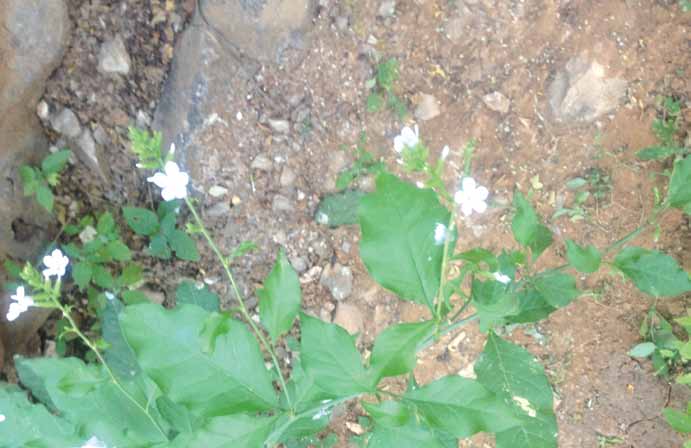
Limonium stocksii (Boiss.) Kuntze
خزامى البحر، جيسب
For people
- Eaten by people
- Unknown
- Toxic to people
- Unknown
For livestock
- Grazed by livestock
- Not grazed
- Toxic to livestock
- Unknown
Edibility and safety notes
No reliable information on whether people can eat this salt-secreting sea lavender was found, and nothing on poisoning either; treat it as not edible. The Omani plant book states that livestock do not graze it; this could not be confirmed from a second source.
This guide is a hobby project, not expert advice. Never eat a wild plant, or feed it to animals, on the strength of this page alone. Read the disclaimer
Description
A small shrub with erect stems up to 60 cm tall. Leaves are simple, mostly at the base of the plant, grey-green and spoon-shaped, covered with a layer of salt secreted by glands in the leaf surface. Flowers are crowded on one side of spikes, which are grouped into branched clusters. The calyx is showy, persistent, tubular and five-nerved with dry, papery lobes; the corolla is inconspicuous and shrivels inside the calyx tube after flowering. Stamens 5, styles 5. The fruit is dry, membranous, ovoid, one-seeded and enclosed in the calyx. Flowers almost all year round.
Habitat
Salt-tolerant; grows on saline and sandy soils.
Distribution
Southern Iran, the United Arab Emirates, Oman, Pakistan (Karachi, Sindh, Baluchistan) and north-west India. In Oman the plant book records it from the south.
Pastoral value
Not grazed by livestock, according to the Omani plant book.
Sources
- كتاب نباتات عمان
- GBIF backbone — Limonium stocksii (Boiss.) Kuntze (name match) — api.gbif.org
- GBIF — Limonium stocksii distributions (WCVP, Catalogue of Life) — api.gbif.org
- GBIF — Limonium stocksii occurrence records by country — api.gbif.org
- Wikipedia — Limonium (genus) — en.wikipedia.org