
Leptadenia pyrotechnica (Forssk.) Decne.
مرخ
For people
- Eaten by people
- Edible
- Toxic to people
- Unknown
For livestock
- Grazed by livestock
- Limited fodder
- Toxic to livestock
- Unknown
Edibility and safety notes
Bedouin and Sahelian herders eat the flowers and buds raw and the young, slimy green pods as a vegetable; young shoots are used to flavour soups. Eat only these young parts and in small amounts: the plant belongs to the milkweed family, contains alkaloids and cardiac glycosides, and PROTA states that its safety profile has not been established, although no poisoning of people or livestock is on record. Camels browse it and other livestock take it to some extent, but it is less palatable than other shrubs.
This guide is a hobby project, not expert advice. Never eat a wild plant, or feed it to animals, on the strength of this page alone. Read the disclaimer
Description
A much-branched, broom-like desert shrub up to 3 m tall, almost leafless, with long, slender, erect, cylindrical green branches and roots that may reach 12 m deep. Leaves are small, opposite, linear and appear only on young shoots, falling early. The small, star-shaped, yellowish to greenish-yellow flowers are borne in short axillary clusters. The fruit is a slender, spindle-shaped, finely hairy follicle about 7.5-13 cm long, releasing seeds with a tuft of silky hairs. Flowers March to May.
Habitat
Sandy desert habitats in arid and semi-arid tropics, particularly in the Sahara and Arabian Peninsula. One of the most drought-resistant plants in these regions.
Distribution
Extremely widespread, extending from the Sahara and northern Africa through to Iran and northwest India.
Pastoral value
Browsed by camels; other livestock take it only to some extent, as it is less palatable than other shrubs.
Other uses
Flowers, buds and young pods are eaten by desert people. The bark yields a strong, rot-resistant fibre used for cordage and fishing lines; stems are used for thatching and wickerwork, twigs as chew sticks, and the dried pith and seed hairs as tinder. Used as fuel and planted for sand-dune fixation and desert afforestation. Traditionally used in folk medicine (boiled branches rubbed on swellings, seed oil for rheumatism, stem infusion as a diuretic, flowers and seeds in preparations for colds and coughs).
Sources
- الدليل الحقلي المصور للنباتات البرية في سلطنة عُمان (BOOK.pdf p.31)
- PROTA (Pl@ntUse) — Leptadenia pyrotechnica — plantuse.plantnet.org(PROTA)
- Useful Tropical Plants — Leptadenia pyrotechnica — tropical.theferns.info
- eNature Qatar — Marak (Leptadenia pyrotechnica) — enature.qa
- Flora of Qatar — Leptadenia pyrotechnica — floraofqatar.com
- Wikipedia — Leptadenia pyrotechnica — en.wikipedia.org
From the same family
All in this family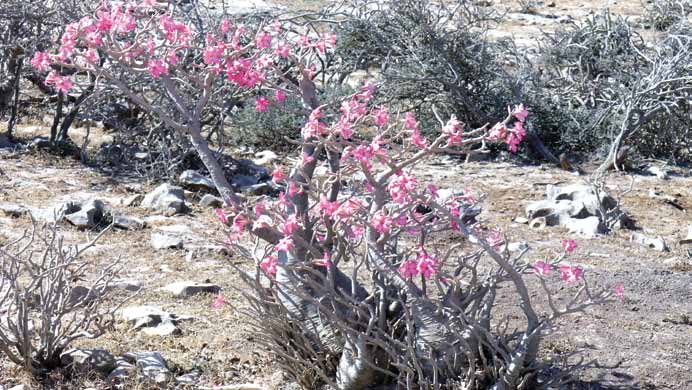
Apocynaceae
Desert rose, Impala lily, Sabi star, Mock azalea
Adenium obesum (Forssk.) Roem. & Schult.
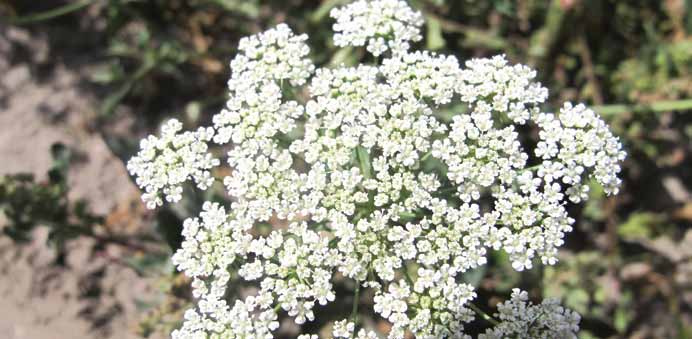
Apiaceae
Bishop's weed, False Queen Anne's lace, Greater ammi, Bishop's flower
Ammi majus L.
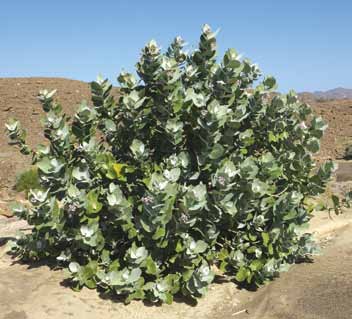
Apocynaceae
Apple of Sodom, Calotrope, Giant milkweed, Sodom apple
Calotropis procera (Aiton) Dryand
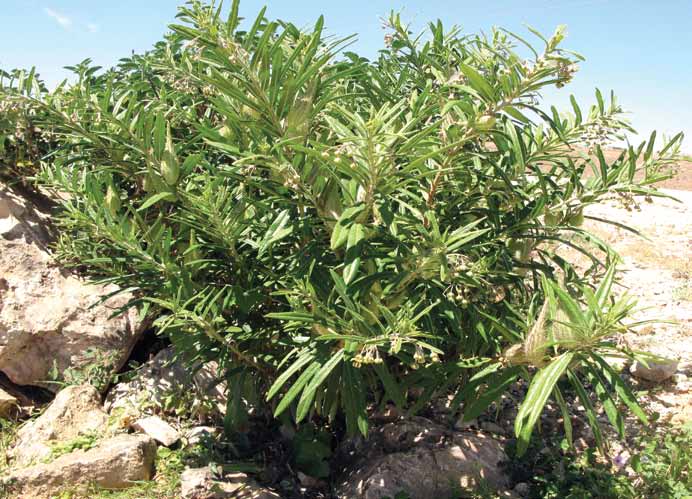
Apocynaceae
Milkweed, Narrow-leaved cotton bush, Balloon cotton bush, Swan plant
Gomphocarpus fruticosus (L.) W.T.Aiton