Reseda aucheri Boiss.
ذنبان. شجرة المطاوعة، قرون الغزال، ذنب ناب
For people
- Eaten by people
- Unknown
- Toxic to people
- Unknown
For livestock
- Grazed by livestock
- Not grazed
- Toxic to livestock
- Unknown
Edibility and safety notes
No reliable information on human edibility or toxicity of this mignonette was found; it is not known as a food plant and should not be eaten. The book states it is not grazed by livestock, and no livestock poisoning is documented.
This guide is a hobby project, not expert advice. Never eat a wild plant, or feed it to animals, on the strength of this page alone. Read the disclaimer
Description
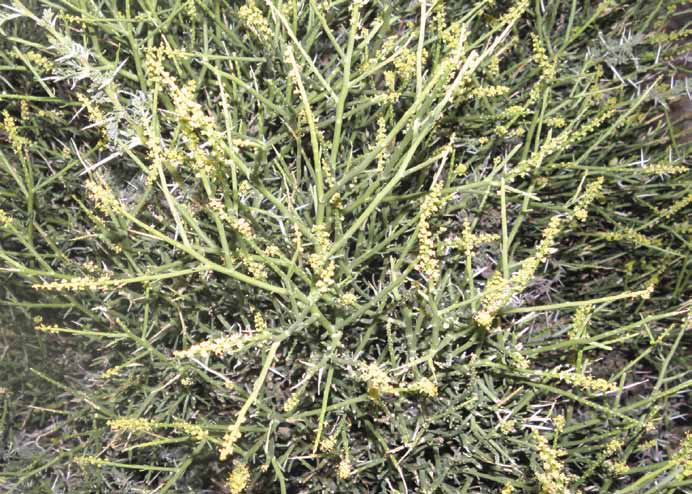
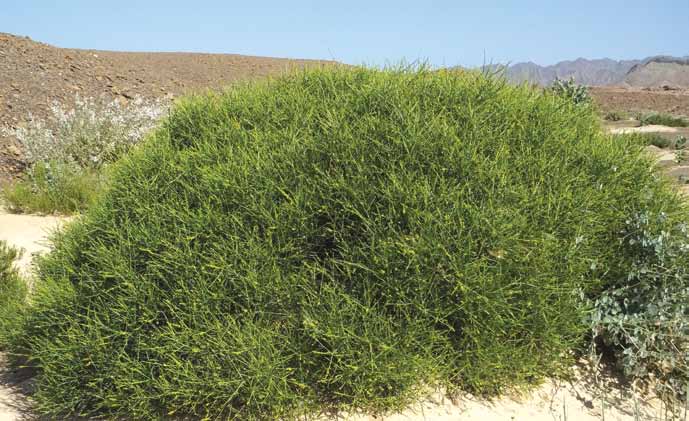
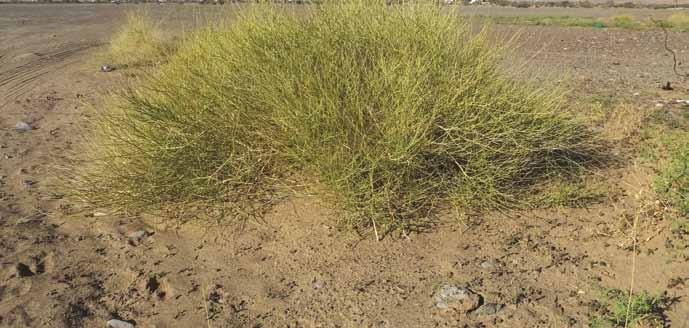
A perennial herb, woody at the base, hairless or slightly hairy, usually with small glandular or warty projections, 30–40 cm tall, with many erect to ascending, simple or branched stems. Leaves simple, 1–5 cm long, wavy, with margins strongly rolled back and clearly warty; lower leaves of sterile shoots obovate to oblong-spathulate narrowing into a stalk, upper leaves linear and blunt. Flowers in loose racemes, bisexual, regular, about 1 cm, almost sessile, with 5 sepals and 5 yellow oblong petals 5–8 mm long, 10 stamens and 5 carpels. The fruit is a five-chambered capsule 3–5 mm long, hairless or woolly, splitting into 5 parts; seeds kidney-shaped and wrinkled. Flowers March–April.
Habitat
Sandy soils and sandy hills.
Distribution
Turkey, Iran, Iraq, Afghanistan, Pakistan and India, and the Arabian Peninsula; in Oman recorded in the north (Muscat, Al Batinah, Musandam).
Pastoral value
Not grazed by livestock.
Other uses
No significant traditional or economic uses documented.
Sources
- الدليل الحقلي المصور للنباتات البرية في سلطنة عُمان (BOOK.pdf p.175)
- GBIF species match — Reseda aucheri Boiss. — api.gbif.org
- GBIF occurrences in Oman — Reseda aucheri — api.gbif.org
- Flora of Qatar — Reseda muricata (related species, for comparison) — floraofqatar.com