Ochradenus aucheri Boiss.
جيش، أسل الجبل، عصا الجبل، قضب
For people
- Eaten by people
- Unknown
- Toxic to people
- Unknown
For livestock
- Grazed by livestock
- Limited fodder
- Toxic to livestock
- Unknown
Edibility and safety notes
No reliable source was found that documents people eating this plant. The claim that the leaves and stems are eaten as a vegetable comes only from an AI-generated text on one website and could not be confirmed anywhere else, so the plant should not be treated as edible. The field guide states that camels graze it; no information on toxicity to people or livestock was found.
This guide is a hobby project, not expert advice. Never eat a wild plant, or feed it to animals, on the strength of this page alone. Read the disclaimer
Description
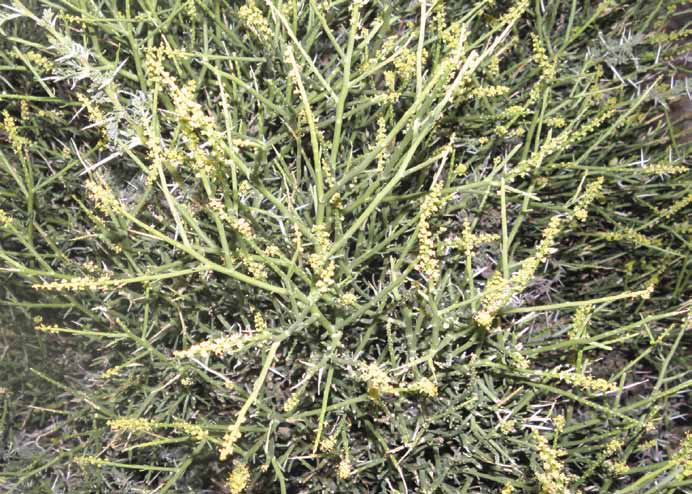
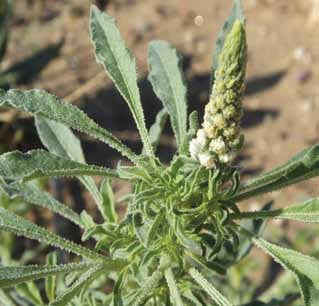
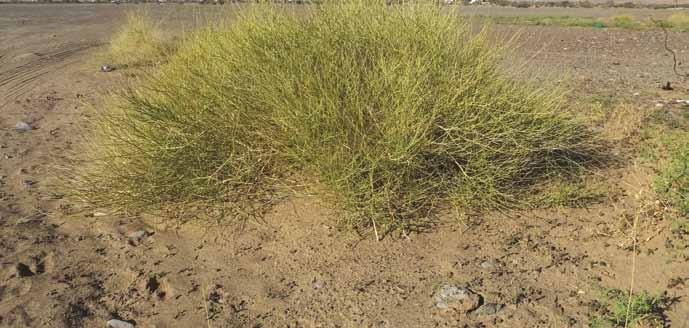
A small perennial shrub with a woody base, up to about 1 m tall. Stems are yellowish-green and glabrous and look leafless because the leaves fall early; leaves are simple, sessile and linear, 1-5 cm long. Flowers are bisexual, about 5 mm across, on stalks 1-2 mm long, in spike-like racemes 10-30 cm long. The fruit is an erect, globose to ovoid, yellowish-brown capsule about 7 x 10 mm with shiny black, smooth seeds. Flowers from February to April.
Habitat
Rocky places and gravelly wadi beds; low hillsides, wadi slopes and roadsides in the mountains.
Distribution
Arabian Peninsula (Oman, United Arab Emirates, Saudi Arabia, Qatar), southern and eastern Iran to south-western Pakistan.
Pastoral value
Grazed by camels.
Other uses
No reliably documented traditional uses were found.
Sources
- الدليل الحقلي المصور للنباتات البرية في سلطنة عُمان (BOOK.pdf p.174)
- Plants of the World Online - Ochradiscus aucheri — powo.science.kew.org
- UAE National Red List - Ochradiscus aucheri — nationalredlist.org
- Flora of Qatar - Ochradenus aucheri (description text is flagged AI-generated) — floraofqatar.com
- Miller (1984) revision of Ochradenus, Notes RBG Edinburgh — journals.rbge.org.uk