Ziziphus hajarensis Duling, Ghaz. & Prend.
قصوم، قصم
For people
- Eaten by people
- Unknown
- Toxic to people
- Unknown
For livestock
- Grazed by livestock
- Limited fodder
- Toxic to livestock
- Unknown
Edibility and safety notes
Researchers at the University of Nizwa report that local people eat the fruits and kernels of this tree straight from the branches, and the site's description calls the fruit sweet and edible, but a second independent published source could not be found, so its edibility is not yet confirmed here. If the ripe fruit is tried, do not swallow the hard stone. Branches are cut to feed the foliage to goats, but the Omani field guide rates the tree as poor grazing. No toxicity studies exist for this rare endemic, and it should not be over-collected.
This guide is a hobby project, not expert advice. Never eat a wild plant, or feed it to animals, on the strength of this page alone. Read the disclaimer
Description
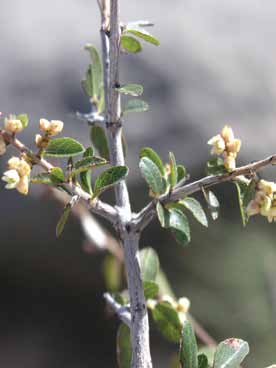
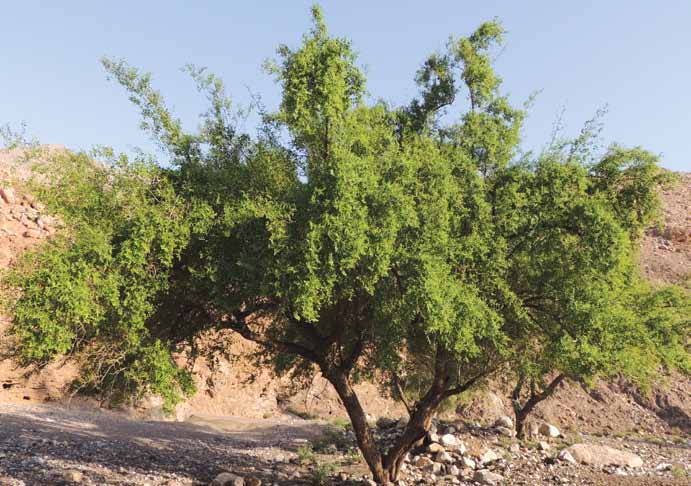
A multi-stemmed shrub or small tree up to about 5 m tall, with paired, straight spines of equal length; young branches zig-zag strongly. Leaves simple, alternate, ovate to almost round, entire or finely toothed, leathery, 2-5 cm long and 1.5-4 cm wide, dark glossy green above, paler and downy beneath. Flowers small, yellowish green, in axillary clusters, with 5 sepals, 5 small petals and 5 stamens. Fruit a globose to ovoid drupe 1-1.5 cm across, orange to brown when ripe, with sweet edible flesh around a single stone; fruits stay on the tree for several months.
Habitat
Mountain habitats in high temperature and low precipitation climates (25-46 C average). Found in open woodland in Western and Eastern Hajar mountains.
Distribution
Endemic to the Hajar mountains of northern Oman: the Western Hajar (including Jabal al Akhdar, where it grows with Juniperus) and the Eastern Hajar (open woodland with Ceratonia oreothauma and Prunus arabica).
Pastoral value
Poor grazing. Local people cut down the foliage to feed goats, using peeled branches as tools.
Other uses
Local people eat the fruits and kernels straight from the tree, where the fruits persist for several months. Peeled branches are used as tools to bring down and cut foliage for goat fodder. The species is regarded as a medicinal plant, though its uses are little documented, and it is of conservation interest as an Omani endemic.
Sources
- الدليل الحقلي المصور للنباتات البرية في سلطنة عُمان (BOOK.pdf p.178)
- PMC — First complete plastome of the endemic Ziziphus hajarensis (introduction: description, distribution, fruit and kernels eaten, goat fodder) — pmc.ncbi.nlm.nih.gov
- POWO — Ziziphus hajarensis Duling, Ghaz. & Prend. (accepted; native to Oman; seen in search results) — powo.science.kew.org
- IPNI — author record Duling, Darrin W. (search result) — ipni.org
- Wikipedia — Ziziphus (genus overview; secondary) — en.wikipedia.org
- Europe PMC search results for Ziziphus hajarensis — ebi.ac.uk