Sageretia thea (Osbeck) M.C.Johnst.
منت
For people
- Eaten by people
- Edible
- Toxic to people
- Unknown
For livestock
- Grazed by livestock
- Unknown
- Toxic to livestock
- Unknown
Edibility and safety notes
The small ripe fruits (black to purple-black, about 5–8 mm) are eaten raw by people, and the leaves have been used as a tea substitute. Sources list no known hazards, but one database notes conflicting reports on the edibility of the fruit, so eat only fully ripe fruit in small amounts and only when the shrub is identified with certainty; other mountain shrubs also bear small dark berries. The hard seeds are not eaten. The Omani book lists it as browsed by livestock, but this could not be confirmed from other sources; no report of animal poisoning was found.
This guide is a hobby project, not expert advice. Never eat a wild plant, or feed it to animals, on the strength of this page alone. Read the disclaimer
Description
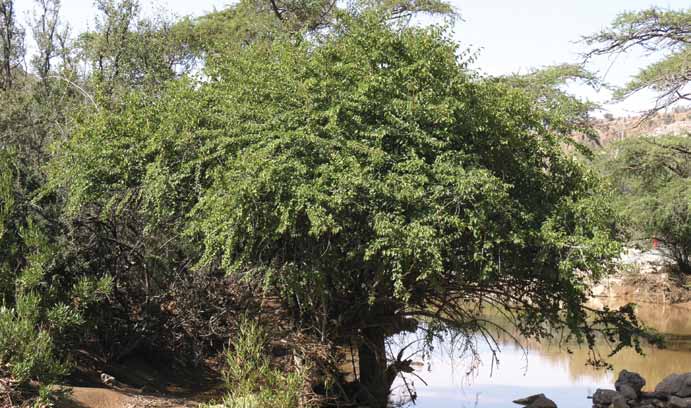
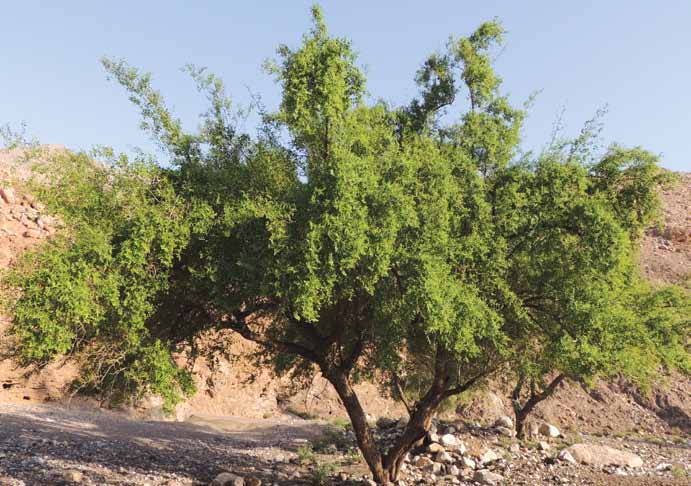
A shrub 1–2 m tall (up to 3 m), evergreen to semi-deciduous, with spine-tipped branchlets. Leaves simple, alternate, ovate to oblong, 1–3 cm long and 0.5–1.5 cm wide, entire or finely toothed, leathery, glossy green above and paler beneath. Flowers small, yellowish-green, five-parted, in short axillary spikes. The fruit is a small globose drupe 5–8 mm across, black to purple-black when ripe, sweet and edible, containing 1–3 hard seeds. Flowers for much of the year.
Habitat
Rock crevices in the mountains. Elsewhere in its range it grows in mountain forests and thickets and on hills, up to about 2100 m.
Distribution
From north-eastern Africa (Eritrea, Ethiopia, northern Somalia) and Sinai through the Arabian Peninsula, Turkey, northern Iraq, Iran and Afghanistan to the Indian subcontinent, China, Japan and South-East Asia. In Oman it grows in the highlands of Jabal Akhdar and the neighbouring mountains (Jabal Shams) in the north.
Pastoral value
Browsed by livestock according to the field guide.
Other uses
The ripe fruits are eaten raw and the leaves are used in some countries as a tea substitute. The wood is very hard. Widely grown as a bonsai plant because of its small leaves.
Sources
- الدليل الحقلي المصور للنباتات البرية في سلطنة عُمان (BOOK.pdf p.177)
- Useful Tropical Plants — Sageretia thea — tropical.theferns.info
- Wikipedia — Sageretia theezans — en.wikipedia.org
- GBIF species match — Sageretia thea (Osbeck) M.C.Johnst. — api.gbif.org
- GBIF occurrences in Oman — Sageretia thea — api.gbif.org
- Useful Temperate Plants – Sageretia thea — temperate.theferns.info
- POWO – Sageretia thea — powo.science.kew.org