Ziziphus spina-christi (L.) Desf.
السدر، السدر البري، السدر المزروع، مكي، الثمرة: نبق
For people
- Eaten by people
- Edible
- Toxic to people
- Not toxic
For livestock
- Grazed by livestock
- Good fodder
- Toxic to livestock
- Not toxic
Edibility and safety notes
The ripe fruit (nabaq) is eaten fresh or sun-dried and ground into a meal; it is widely collected and sold in Omani markets. Eat the flesh only and discard the hard stone. Sidr honey from its flowers is highly valued. Leaves, bark and roots are medicinal or used for washing, not food. The foliage is browsed by camels and goats and the fallen fruits are eaten by sheep and goats; it is a useful dry-season feed, although tannins lower its protein value. Beware of the sharp paired thorns.
This guide is a hobby project, not expert advice. Never eat a wild plant, or feed it to animals, on the strength of this page alone. Read the disclaimer
Description
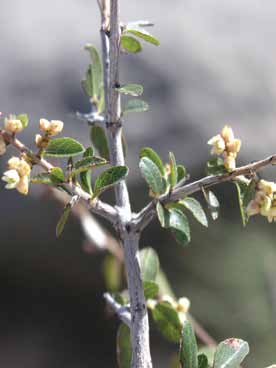
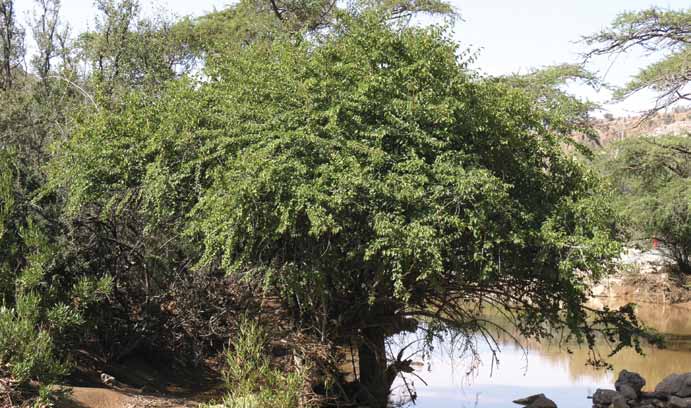
An evergreen tree 3-8 m tall (occasionally taller) with a main trunk and a usually rounded or ovoid crown; branches ascending and spreading, fairly long, white to grey, hairless. Stipular spines strong, paired: one straight, about 1 cm or more, the other hooked and shorter; spines are sometimes absent. Leaves simple, alternate, in two rows, 2-8 x 1.5-3 cm, elliptic or ovate to oblong, blunt or pointed, faintly scalloped, three-veined, hairless or downy on the veins beneath; leaf stalk 5-15 mm. Flowers bisexual, yellowish green, 4-6 mm across, in axillary cymes on stalks 3-5 mm long; sepals 5, woolly outside; petals 5, yellow, shorter than the sepals; stamens 5. Fruit a fleshy, globose drupe 1-1.5 cm across, yellowish when ripe; seeds dark brown, 5-6 mm long. Flowers September-April.
Habitat
Oases in hot deserts, wadi beds and coastal hillsides; also fields on alluvial soils.
Distribution
A Sudanian species extending into the warmer parts of the Mediterranean, Saharo-Arabian and western Irano-Turanian regions (Africa from Senegal to Somalia and Egypt, the Levant, Arabia and east to Pakistan). Found in all regions of Oman.
Pastoral value
Browsed by camels and goats; the fruits are also eaten by sheep and goats.
Other uses
A bee-forage, medicinal and food tree. The fruits (nabaq) are eaten, especially when fresh, being sweet and nutritious; some people sun-dry, grind and sieve them. Traditionally the fruits are used for measles and gall-bladder complaints and as a laxative, blood purifier, expectorant and fever remedy, and for stomach ulcers. The leaves are traditionally used for asthma and chest complaints, diarrhoea, to strengthen the stomach, for heavy menstrual bleeding, abscesses and eye inflammation, mixed with vinegar for snakebite, packed with bark into wounds, and as a decoction against worms and to strengthen the hair. Ground leaves mixed with water are used for washing the dead and as a hair wash; fresh leaves are placed on a child's abdomen for bloating and used when setting fractures. A bark decoction is used for toothache, fever and as a tonic. Bees make the prized sidr honey from the flowers. The tree is widely planted for shade, ornament, windbreaks and erosion control, and its wood is hard, strong and versatile. These are traditional uses, not medical advice.
Sources
- كتاب نباتات عمان
- World Agroforestry Agroforestree Database — Ziziphus spina-christi (food, fodder, description) — apps.worldagroforestry.org
- Wikipedia — Ziziphus spina-christi (ripe fruits edible; distribution; secondary) — en.wikipedia.org
- Feedipedia — fodder tree study incl. Ziziphus spina-christi (good dry-season feed; tannins; search result) — feedipedia.org
- Sultan Qaboos University — In vitro antioxidant activities of Ziziphus spina-christi fruits grown in Oman (search result) — squ.elsevierpure.com
- Oman Observer — It's Sidr fruit season again (search result) — omanobserver.om
- NISC — Nutritional value of Zizyphus spina-christi for goat production, Ethiopia (search result) — nisc.co.za
- Useful Tropical Plants – Ziziphus spina-christi — tropical.theferns.info
- Feedipedia reference – Fadel Elseed et al. 2002 (browse nutritive value, Sudan) — feedipedia.org