Aloe dhufarensis Lavranos
طوف، صرب، صبار، صقل ظفار
For people
- Eaten by people
- Not edible
- Toxic to people
- Unknown
For livestock
- Grazed by livestock
- Not grazed
- Toxic to livestock
- Unknown
Edibility and safety notes
Not a food plant. The bitter leaf juice is used only in folk medicine and as a dye; one of its traditional uses is against constipation, which points to the laxative effect typical of aloe sap, so it should not be eaten or drunk as food. No toxicity study of this species was found. The field guide says livestock do not graze it. It is an endemic of Dhofar and should not be collected from the wild.
This guide is a hobby project, not expert advice. Never eat a wild plant, or feed it to animals, on the strength of this page alone. Read the disclaimer
Description
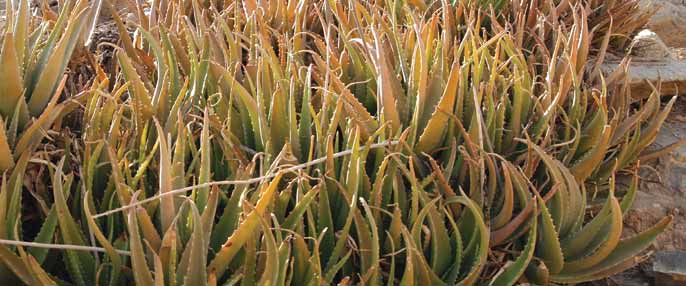
A stemless succulent forming a single ground-level rosette of 10-20 fleshy leaves. The leaves are ascending to erect, triangular and tapering to a hard point, 30-50 cm long and up to 15 cm wide, very pale blue-grey to grey-green or almost white, flat above and convex beneath; the margins are smooth or carry only one or two small teeth near the base. The erect flower spike reaches about 1 m and sometimes has one or two branches. The flowers are about 3 cm long, coral-red to yellow, and appear from April to June. The fruit is an erect three-valved capsule about 1.5 cm long.
Habitat
The drier wadis of Dhofar: dry watercourses and gravel banks on poor alkaline soils, in areas that receive only part of the monsoon mist.
Distribution
Endemic to Dhofar, southern Oman. It grows in large numbers in Wadi Adonib, where it was first discovered.
Pastoral value
Not a grazing plant.
Other uses
The leaf juice is traditionally used in folk medicine for headaches, aching limbs, diabetes and constipation. The dried juice is used in Dhofar as a yellow-orange pigment for decorating pottery and as a cosmetic skin dye, and is sold in the markets of Dhofar.
Sources
- الدليل الحقلي المصور للنباتات البرية في سلطنة عُمان (BOOK.pdf p.36)
- LLIFLE Encyclopedia of Succulents - Aloe dhufarensis — llifle.eu
- British Omani Society - Dhofar brochure (Aloe dhufarensis as an endemic at high densities) — britishomani.org
- Royal Botanic Garden Edinburgh, Notes - record of Aloe dhufarensis restricted to Dhofar — journals.rbge.org.uk
- NCCIH (US National Institutes of Health) - Aloe vera safety (general aloe latex effects) — nccih.nih.gov