Aloe vera (L.) Burm.f.
صقل، صقال، صبار
For people
- Eaten by people
- Not edible
- Toxic to people
- Toxic
For livestock
- Grazed by livestock
- Not grazed
- Toxic to livestock
- Toxic
Edibility and safety notes
Do not treat wild aloe as a food plant. The bitter yellow sap (latex) under the leaf skin and whole-leaf preparations are harmful: they cause cramps and diarrhoea, have been linked to hepatitis and kidney and heart problems with long use, and whole-leaf extract is classed as a possible human carcinogen. Only the clear inner gel, fully separated from skin and sap, is used in commercial drinks and desserts; home preparation risks contamination with the sap. Avoid swallowing it in pregnancy. Livestock do not graze it; it is poisonous to dogs, cats and horses.
This guide is a hobby project, not expert advice. Never eat a wild plant, or feed it to animals, on the strength of this page alone. Read the disclaimer
Description
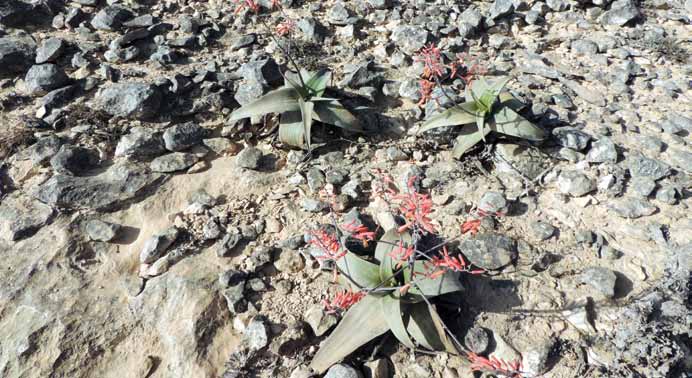
A succulent perennial with a short stem and long, narrow, fleshy pale green to red-green leaves up to 50 cm long arranged in a rosette. Leaves have sharp white or pinkish marginal teeth and tiny white spots. Yellow tubular flowers borne on a branched inflorescence up to 100 cm tall.
Habitat
Sandy places and roadsides in sunny positions; widely planted in gardens and farms.
Distribution
Native to the south-east Arabian Peninsula (Hajar Mountains, north-eastern Oman and eastern UAE). Widely cultivated and naturalized globally including North Africa, Canary Islands, and many tropical regions.
Pastoral value
Not a grazing plant.
Other uses
The leaf gel is widely used on the skin, traditionally for burns, sunburn, wounds, cracked skin, itching and insect bites, and in hair care; it is a major ingredient of cosmetics. The inner gel is also used in drinks, yoghurts and desserts. The bitter yellow leaf sap (latex) was traditionally taken as a laxative, but this use is no longer considered safe. In Omani folk medicine the plant is also used for stomach, chest, joint and eye complaints.
Sources
- الدليل الحقلي المصور للنباتات البرية في سلطنة عُمان (BOOK.pdf p.37)
- NCCIH (US National Institutes of Health) - Aloe vera: usefulness and safety — nccih.nih.gov
- NIEHS (US National Institutes of Health) - Aloe vera — niehs.nih.gov
- ASPCA Animal Poison Control - Aloe — aspca.org
- Wikipedia - Aloe vera — en.wikipedia.org
- Plants For A Future - Aloe vera — pfaf.org