Centaurea pseudosinaica Czerep.
مرار، كسكاس
For people
- Eaten by people
- Unknown
- Toxic to people
- Unknown
For livestock
- Grazed by livestock
- Limited fodder
- Toxic to livestock
- Unknown
Edibility and safety notes
No reliable information on human edibility or toxicity of this spiny annual knapweed was found; do not eat it. The Omani field guide rates it as good grazing for camels, and the UAE Red List assessment notes that livestock grazing affects its populations, so it is eaten by livestock, mainly camels; no livestock toxicity is recorded.
This guide is a hobby project, not expert advice. Never eat a wild plant, or feed it to animals, on the strength of this page alone. Read the disclaimer
Description
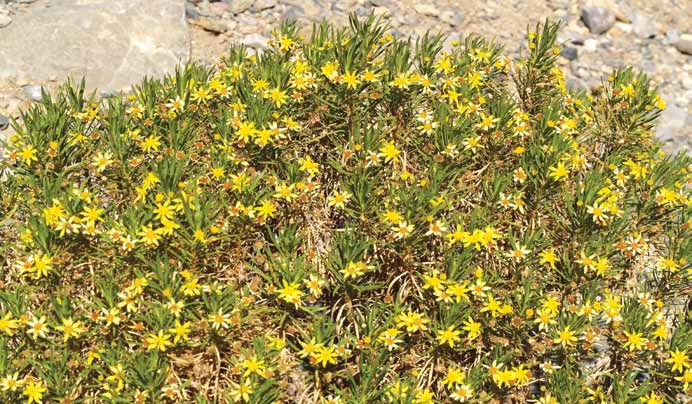
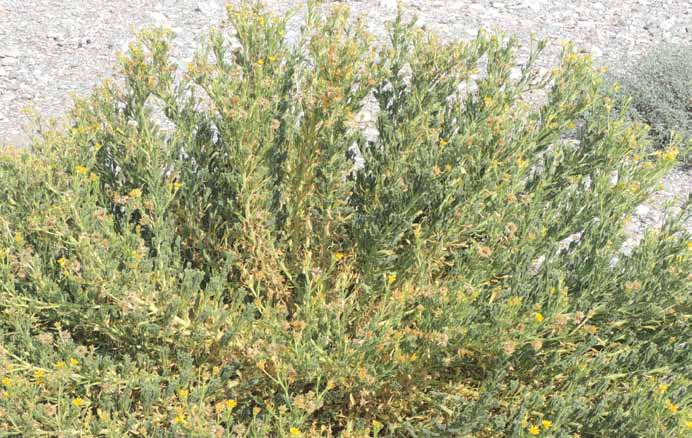
An annual herb branched from the base, up to 30 cm tall, densely covered with short hairs. Stems erect, with toothed wings. Basal leaves stalked, lyrate and deeply lobed to the midrib; upper leaves smaller, less deeply lobed, linear-lanceolate with spiny-toothed margins, their bases running down the stem. Flower heads solitary, yellow, about 20 mm across; involucral bracts ovate, each ending in a spine about 20 mm long with 1-3 pairs of short spinelets 3-5 mm long at its base. Achene 3.5 mm long with a pappus 3-4 mm long. Flowers in April.
Habitat
Sandy-loamy terraces in wadis and depressions, and coarse sand between rock outcrops; elsewhere in Arabia also on coastal sands and sandy plains.
Distribution
Native range from Iraq to southern Iran and the Arabian Peninsula, including the Gulf States, Kuwait, Oman, Saudi Arabia and Yemen.
Pastoral value
Rated as good grazing for camels by the Omani field guide; livestock grazing is noted as a pressure on its populations in the UAE.
Other uses
Limited documented uses.
Sources
- الدليل الحقلي المصور للنباتات البرية في سلطنة عُمان (BOOK.pdf p.39)
- Plants of the World Online — Centaurea pseudosinaica Czerep. — powo.science.kew.org
- National Red List (UAE) — Centaurea pseudosinaica — nationalredlist.org
- Plants of the World Online — Centaurea pseudosinaica subsp. niebuhrii Wagenitz — powo.science.kew.org