
Ceratonia oreothauma Hillc., G.P.Lewis & Verdc.
For people
- Eaten by people
- Unknown
- Toxic to people
- Unknown
For livestock
- Grazed by livestock
- Limited fodder
- Toxic to livestock
- Unknown
Edibility and safety notes
The site's source book says the young, soft pods are eaten by people and that animals eat the pods and leaves, but no second independent source confirming human food use or safety could be found, so edibility is left as unknown. Do not assume it can be used like the cultivated carob (Ceratonia siliqua), which is a different species. This is a rare, threatened tree known in Oman from a very small area of the Eastern Hajar; it should not be harvested.
This guide is a hobby project, not expert advice. Never eat a wild plant, or feed it to animals, on the strength of this page alone. Read the disclaimer
Description
A small evergreen tree, usually 4-5 m tall (reported up to 8 m), with a stout cylindrical trunk, gnarled branches and rough bark. Leaves are pinnate with 3-5 pairs of leaflets according to the Omani source (other sources give up to 20 leaflets). Flowers are borne in clusters, male and female flowers separate, greenish, yellowish or reddish. Fruits are long, flat, broad, slightly curved pods borne in groups; seeds are flattened, green before ripening and green to brown when ripe. Flowers from February to April.
Habitat
Mountain slopes and valleys of the Eastern Hajar range at about 900-2000 m; rarely lower.
Distribution
Subsp. oreothauma is known only from the Eastern Hajar Mountains of Oman (Jebel Aswad); subsp. somalensis grows in the mountains of Somaliland. It is distinct from the cultivated carob (Ceratonia siliqua) of the Mediterranean region.
Pastoral value
According to the Omani source, animals eat the pods and leaves of this tree.
Other uses
According to the Omani source, the pods are eaten while young and soft, and the wood is used for building huts and as firewood, especially in winter, because it burns strongly with a pleasant smell.
Sources
- كتاب نباتات عمان
- Wikipedia - Ceratonia oreothauma — en.wikipedia.org
- USDA GRIN-Global - Ceratonia oreothauma Hillc. et al. — npgsweb.ars-grin.gov
From the same family
All in this family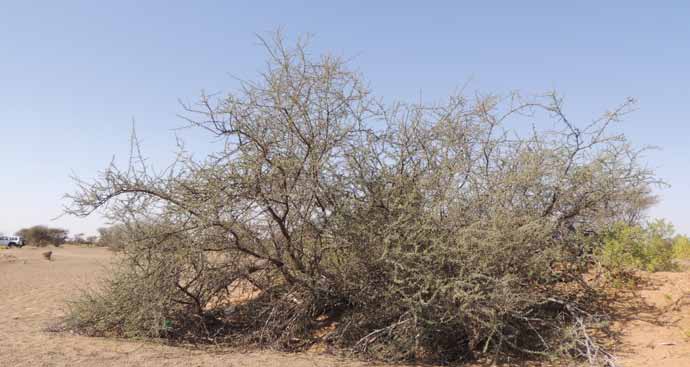
Fabaceae
Salam tree, Desert acacia
Acacia ehrenbergiana Hayne.
Fabaceae
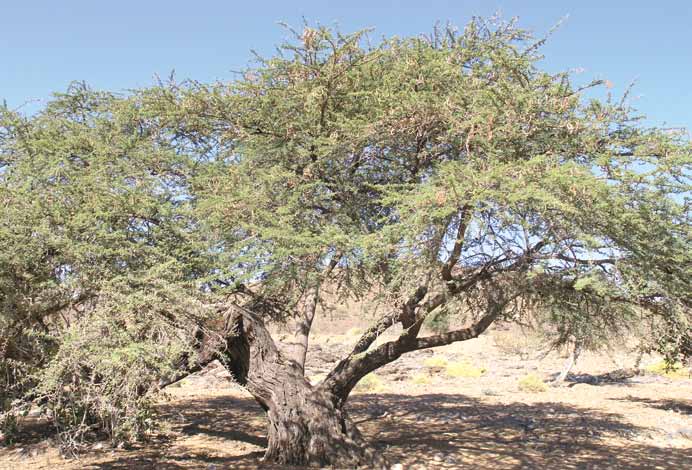
Red thorn, Grey-haired acacia, Talh
Acacia gerrardii Benth.
Fabaceae
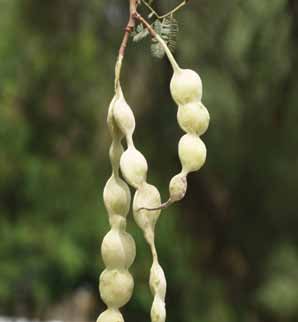
Gum arabic tree, Babul, Thorn mimosa, Egyptian acacia, Thorny acacia
Acacia nilotica (L.) Del.
Fabaceae
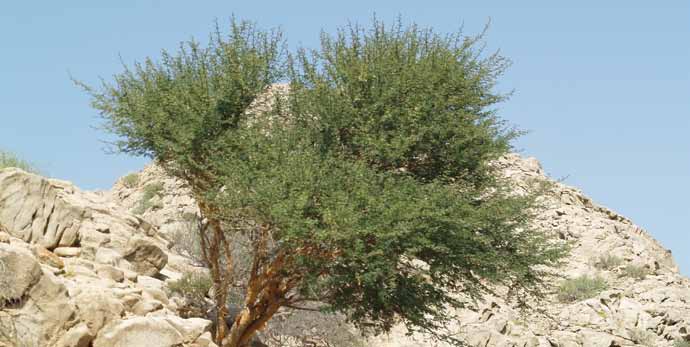
Gum acacia, Gum arabic tree, Sudan gum
Acacia senegal (L.) Willd.