Convolvulus cephalopodus Boiss.
الرخامى، رخامه
For people
- Eaten by people
- Unknown
- Toxic to people
- Unknown
For livestock
- Grazed by livestock
- Limited fodder
- Toxic to livestock
- Unknown
Edibility and safety notes
No reliable record was found of people eating this plant, so it should not be eaten. A single laboratory test of a water extract in mice showed no acute toxicity, which is not enough to call the plant safe for people; other bindweeds contain alkaloids and purgative resins. The Omani field guide says camels and goats graze it; no other source on forage value or livestock poisoning was found.
This guide is a hobby project, not expert advice. Never eat a wild plant, or feed it to animals, on the strength of this page alone. Read the disclaimer
Description
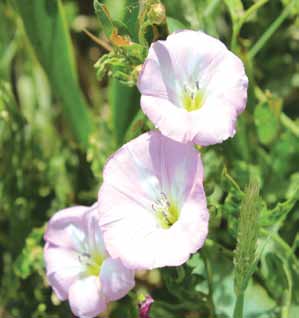
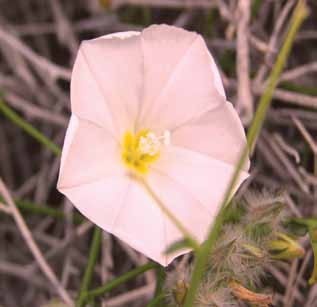
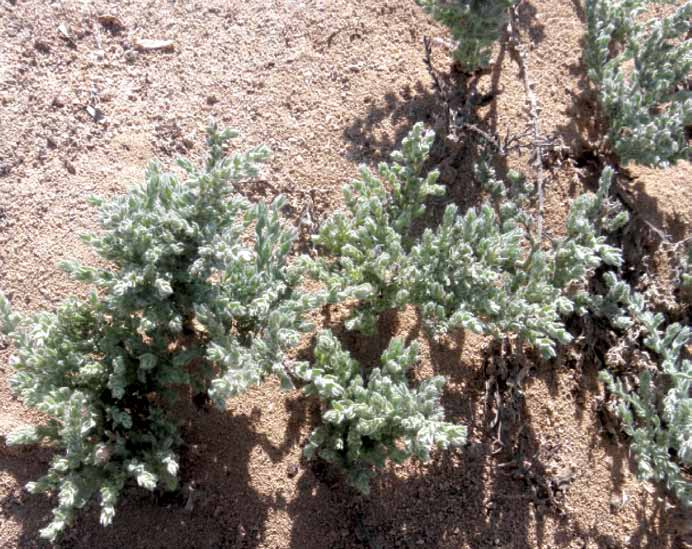
An erect or decumbent herb or undershrub, 14-50 cm tall, with a branched woody base. Lower leaves are oblanceolate, upper leaves broadly elliptic to ovate, all with wavy margins and tomentose surface. Flowers are white-pink, axillary, up to 4 in a cymose head.
Habitat
Stable coastal sands, sand plains and low dunes, sometimes on gravel or silty ground inland and in low mountain localities; tolerates disturbed ground and roadsides.
Distribution
Native to the Arabian Peninsula, Iraq, Iran and Pakistan. Found in Gulf States, Kuwait, Oman and Saudi Arabia.
Pastoral value
Grazed by camels and goats, according to the Omani field guide.
Other uses
No traditional uses were found. The plant is listed in the UAE encyclopedia of medicinal plants, which reports laboratory tests only.
Sources
- الدليل الحقلي المصور للنباتات البرية في سلطنة عُمان (BOOK.pdf p.86)
- UAE Department of Health, Encyclopedia of Medicinal Plants of UAE — Convolvulus cephalopodus — medicinalplants.doh.gov.ae
- UAE National Red List — Convolvulus cephalopodus — nationalredlist.org
- Flora of Qatar — Convolvulus cephalopodus — floraofqatar.com
- Plants of the World Online — Convolvulus cephalopodus Boiss. (seen in search results) — powo.science.kew.org