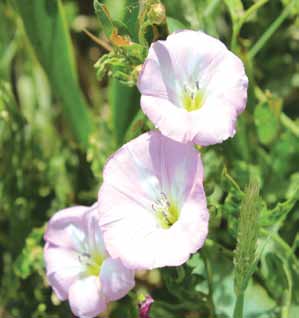
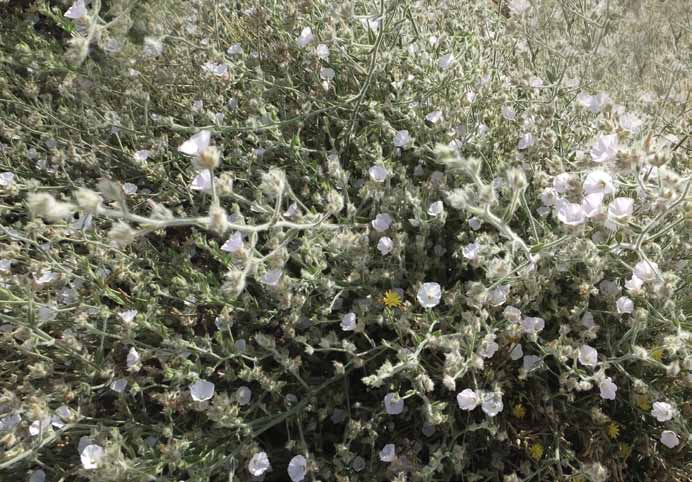
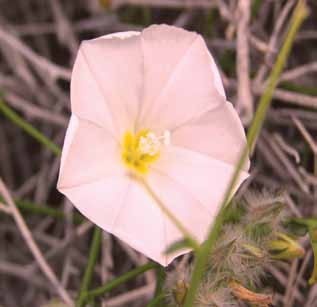
Cressa cretica L.
ندوة، شويل
For people
- Eaten by people
- Unknown
- Toxic to people
- Unknown
For livestock
- Grazed by livestock
- Good fodder
- Toxic to livestock
- Not toxic
Edibility and safety notes
Not a food plant in Arabia; the only record of people eating it is a historical note from India that the herb was eaten, and PROTA describes its taste as sour and unpleasant. It is widely used in traditional medicine and no poisoning is reported, but its safety as food has not been established. Sheep, goats and camels graze it in saline habitats and it is regarded as good fodder.
This guide is a hobby project, not expert advice. Never eat a wild plant, or feed it to animals, on the strength of this page alone. Read the disclaimer
Description
A much-branched, greyish, hairy perennial herb or small subshrub 10-25 cm tall, with ascending or prostrate leafy stems. Leaves are small (2-9 mm), sessile, ovate-oblong to lanceolate, entire, pointed, and excrete salt. Flowers are small, sessile and bell-shaped, whitish to pale pink or yellowish, with five free sepals about 3 mm long and five protruding stamens; they are borne in short spike-like clusters in the upper leaf axils. The fruit is an ovoid capsule 3-4 mm long opening by two valves and usually containing one or two shiny, hairless seeds. A halophyte; flowers May to November.
Habitat
Grows in sandy or muddy saline habitats along the sea coast. Classified as a thermocosmopolitan halophilous species.
Distribution
Found in northern and central Africa, southern Europe, western Asia, the Arabian Peninsula, the Middle East, southeastern Asia, India, Sri Lanka and Australia.
Pastoral value
Good fodder: grazed by sheep and goats in saline and coastal habitats and occasionally browsed by camels.
Other uses
Traditionally used in folk medicine (India, Bahrain, Africa) for diabetes, ulcers, asthma, constipation, skin complaints and as an expectorant and tonic. Laboratory studies report antibacterial, antifungal and antitussive activity. Also valued as a soil binder in coastal saline areas.
Sources
- الدليل الحقلي المصور للنباتات البرية في سلطنة عُمان (BOOK.pdf p.88)
- PROTA (Plant Resources of Tropical Africa) - Cressa cretica — plantuse.plantnet.org(PROTA)
- Purdue Famine Foods - Cressa cretica — purdue.edu
- Wikipedia - Cressa cretica — en.wikipedia.org
- Flora of Qatar - Cressa cretica — floraofqatar.com
- RBGE herbarium specimen E00128849 (Cressa cretica, Masirah, Oman) — data.rbge.org.uk
- ICAR Indian Farming - Halophytic fodder for saline-sodic ecosystems — epubs.icar.org.in