Cucumis prophetarum L.
حنيظلان، لوماة الهرش، حيدق، شري الدئب، بطيخ
For people
- Eaten by people
- Not edible
- Toxic to people
- Toxic
For livestock
- Grazed by livestock
- Limited fodder
- Toxic to livestock
- Unknown
Edibility and safety notes
The small spiny, striped fruit is intensely bitter and contains cucurbitacins; in Pakistan and Arabia it is used only as an emetic and purgative, and eating it can cause vomiting and severe diarrhoea. In parts of Africa the very young fruits and the cooked leaves are reported as food after boiling or pickling, but this is not an Omani practice and the bitter wild fruit should not be eaten. The field guide rates it as poor grazing; no livestock poisoning by this species is documented, but bitter cucurbits in general are suspected of poisoning stock.
This guide is a hobby project, not expert advice. Never eat a wild plant, or feed it to animals, on the strength of this page alone. Read the disclaimer
Description
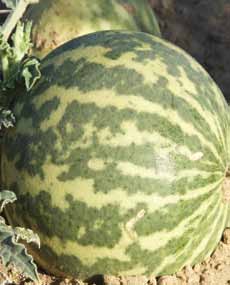
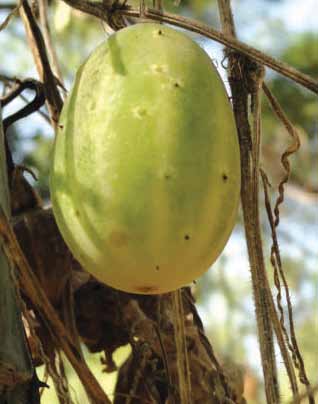
A perennial trailing or climbing herb with a thick horizontal rootstock and slender hairy stems; tendrils short and unbranched, sometimes absent. Leaves are rough on both surfaces, roundish in outline, 2-4 cm, with a heart-shaped base and wavy or shallowly lobed margins. Flowers are small and yellow, unisexual, with five sepals and a five-lobed corolla; male flowers single or in small clusters, female flowers single with a spiny ovary. The fruit is ellipsoid, 3-4 cm long, on a thick stalk, covered with soft spines and bearing about ten alternating green and white longitudinal stripes, turning yellow when ripe; the pulp is very bitter and the many seeds are flattened, smooth and ellipsoid. Flowers March to May.
Habitat
Dry stony and sandy ground, semi-desert scrub and bushland, wadi beds and sandy coastal plains.
Distribution
Eastern Saharo-Arabian region extending into the Sudanian region: from Mauritania across tropical Africa to the Horn of Africa, and from the Levant through Arabia (Yemen, Oman) to Pakistan and north-west India. In Oman it occurs in all regions except the high mountains.
Pastoral value
Poor grazing value according to the Omani field guide; the bitter plant is little used by livestock.
Other uses
Traditionally used in folk medicine for liver complaints, stomach pain, diabetes and venereal disease; in Pakistan and Arabia the bitter fruit is used as an emetic and purgative. The fruits contain cucurbitacins, which have been studied for cytotoxic activity.
Sources
- كتاب نباتات عمان
- Useful Tropical Plants - Cucumis prophetarum — tropical.theferns.info
- Wikipedia - Cucumis prophetarum — en.wikipedia.org
- Pakistan Journal of Scientific and Industrial Research 18 (1975) - cucurbitacins of the fruits of Cucumis prophetarum — pjsir.org
- Flora of Qatar - Cucumis prophetarum — floraofqatar.com
- GBIF species match - Cucumis prophetarum L. — api.gbif.org
- Alsayari et al. 2018, anticancer cucurbitacins from Cucumis prophetarum (PMC) — pmc.ncbi.nlm.nih.gov