
Datura innoxia Mill.
مرنحه، داتورة لاشوكية
For people
- Eaten by people
- Not edible
- Toxic to people
- Toxic
For livestock
- Grazed by livestock
- Not grazed
- Toxic to livestock
- Toxic
This guide is a hobby project, not expert advice. Never eat a wild plant, or feed it to animals, on the strength of this page alone. Read the disclaimer
Description
• Growth and form: A wild annual herb or small shrub, usually 50–150 cm tall. It has a branching stem and broad, pointed leaves with irregularly toothed edges. The leaves give off a strong, unpleasant smell when crushed. • Flowers: Large, tubular and trumpet-shaped, bright white or sometimes tinged pale violet. They usually open in the evening and at night. • Fruit and seeds: The fruit is a round or oval capsule covered all over in soft spines. When ripe it dries and splits open, releasing black or dark brown kidney-shaped seeds.
Habitat
Native to Central and South America; introduced to the other continents.
Distribution
Murannaha grows wild in many wilayats of the Sultanate. It is common in wadi beds, watercourses, abandoned farms and along roadsides. It is most noticeable in areas that get seasonal rain, such as some wadis in North and South Al Batinah, Ad Dakhiliyah and Ad Dhahirah governorates, and on some plains and plateaus of Dhofar Governorate after the khareef season.
Pastoral value
No grazing value, and dangerous: Murannaha has no positive value as forage. It is classed as a toxic plant that is very dangerous to livestock. Effect on livestock: The plant contains highly potent toxic alkaloids, such as atropine and scopolamine. Livestock such as camels, sheep and cattle instinctively avoid it because of its repellent smell and bitter taste. The danger comes when its dried leaves or seeds get mixed into harvested fodder. Signs of poisoning in animals: If eaten by mistake, it causes acute poisoning, with a rapid heartbeat, dry mucous membranes, agitation and loss of balance. In severe cases it leads to respiratory failure and death.
Other uses
• Medicinal: Important alkaloids, such as atropine and scopolamine, are extracted from it to make eye medicines, motion-sickness remedies and bronchodilators. • Traditional: Compresses made from its leaves are applied externally only, to ease rheumatic and joint pain. • Agricultural: Its extracts are used as an insecticide and a natural pest repellent.
Sources
From the same family
All in this family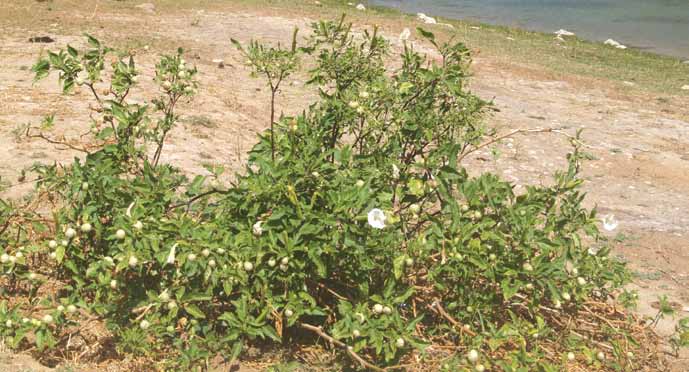
Comments1
- Haitham Alyahyaai
معلومة قيمة