Solanum incanum L.
الشرجنبان، حلقام، عرصم الشربيان
For people
- Eaten by people
- Not edible
- Toxic to people
- Toxic
For livestock
- Grazed by livestock
- Not grazed
- Toxic to livestock
- Toxic
Edibility and safety notes
Poisonous: do not eat. All parts contain glycoalkaloids (mainly solasonine), most concentrated in the bitter yellow fruits, which look like small tomatoes or eggplants and are a risk to children. The fruit also contains dimethylnitrosamine, a potent carcinogen linked to oesophageal cancer where the fruit or seeds are used to curdle milk, so the traditional cheese-making use is not recommended. Livestock usually avoid the spiny plant; in a feeding trial unripe fruits caused nervous signs and death in sheep.
This guide is a hobby project, not expert advice. Never eat a wild plant, or feed it to animals, on the strength of this page alone. Read the disclaimer
Description
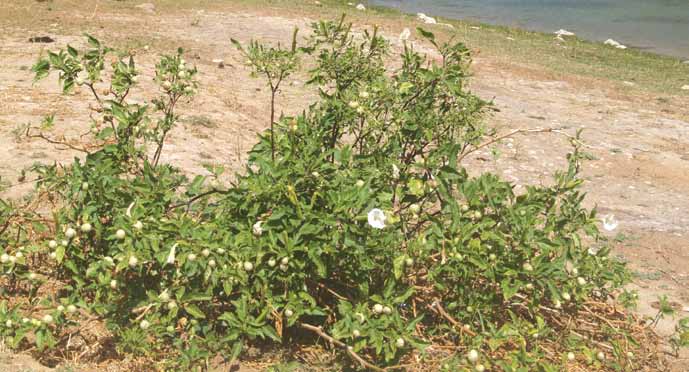
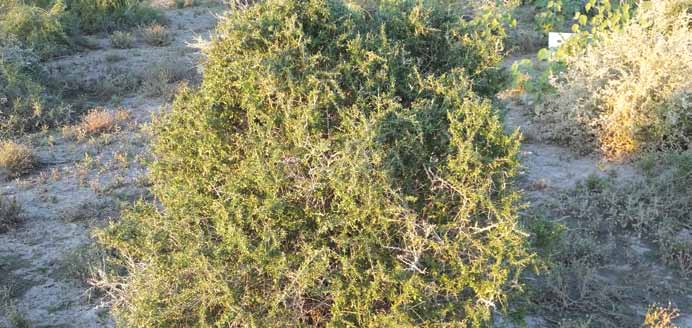
A spiny shrub, usually 60-150 cm tall (reported up to 3 m), branched from the base and densely covered with yellowish, woolly star-shaped hairs; the stems bear short curved prickles with thick bases. Leaves simple, alternate, broadly ovate, with wavy to shallowly lobed margins, unequal at the base, with prickles along the midrib. Flowers in clusters of 2-15, wheel-shaped, 2-2.5 cm across, blue, pink, purple or violet, rarely white, with yellow anthers. Fruit a nearly globose berry about 2.5-3.5 cm across, yellow (to orange or brown) when ripe, with many pale yellow to brown lens-shaped seeds 2.5-3 mm long. Flowers January to August.
Habitat
Forest edges, bushland, and grassland from sea level to 2500 m. Abundant around houses, in overgrazed grassland, and on roadsides.
Distribution
Throughout continental Africa and from the Middle East eastward to India; recorded from many localities in Oman. Introduced in Taiwan and Vietnam.
Pastoral value
Poisonous to livestock and generally avoided because of its prickles and toxicity. Its presence indicates overgrazing.
Other uses
Traditionally the fruit and seeds are used in Arabia and Africa to curdle milk for cheese, and extracts of the stem and fruit pulp are applied to skin complaints; in Africa it is used in folk medicine mainly for pain relief (sore throat, stomach-ache, headache, toothache). The fruit is also an ingredient of arrow and fish poisons and its sap is applied to cattle against ticks. Caution: the fruit is toxic and contains the carcinogen dimethylnitrosamine, which has been linked to oesophageal cancer where it is used to curdle milk.
Sources
- الدليل الحقلي المصور للنباتات البرية في سلطنة عُمان (BOOK.pdf p.188)
- PROTA (Plant Resources of Tropical Africa) - Solanum incanum — plantuse.plantnet.org(PROTA)
- The Kenya Veterinarian (AJOL) - toxicity of unripe Solanum incanum fruits in sheep — ajol.info
- Biochemistry Research International 2020 - Ficus carica and Solanum incanum extracts in coagulation of milk, Afar, Ethiopia — ncbi.nlm.nih.gov
- Wikipedia - Solanum incanum — en.wikipedia.org