Lycium shawii Roem. & Schult.
قصد، شمقص، أوساج، عوسج، شاذ، صرمي
For people
- Eaten by people
- Edible
- Toxic to people
- Unknown
For livestock
- Grazed by livestock
- Good fodder
- Toxic to livestock
- Not toxic
Edibility and safety notes
The small, ripe red berries are sweet and are eaten raw by people in Arabia; in East Africa the salty leaves are chopped and cooked as a vegetable. Eat only fully ripe red berries and in moderation: they are reported to be laxative, and this is a nightshade-family plant whose unripe fruit and other parts have not been shown to be safe, so do not eat green berries or raw leaves. The shrub is very thorny. Camels, goats and other livestock readily browse the leaves and new growth, with no harm reported.
This guide is a hobby project, not expert advice. Never eat a wild plant, or feed it to animals, on the strength of this page alone. Read the disclaimer
Description
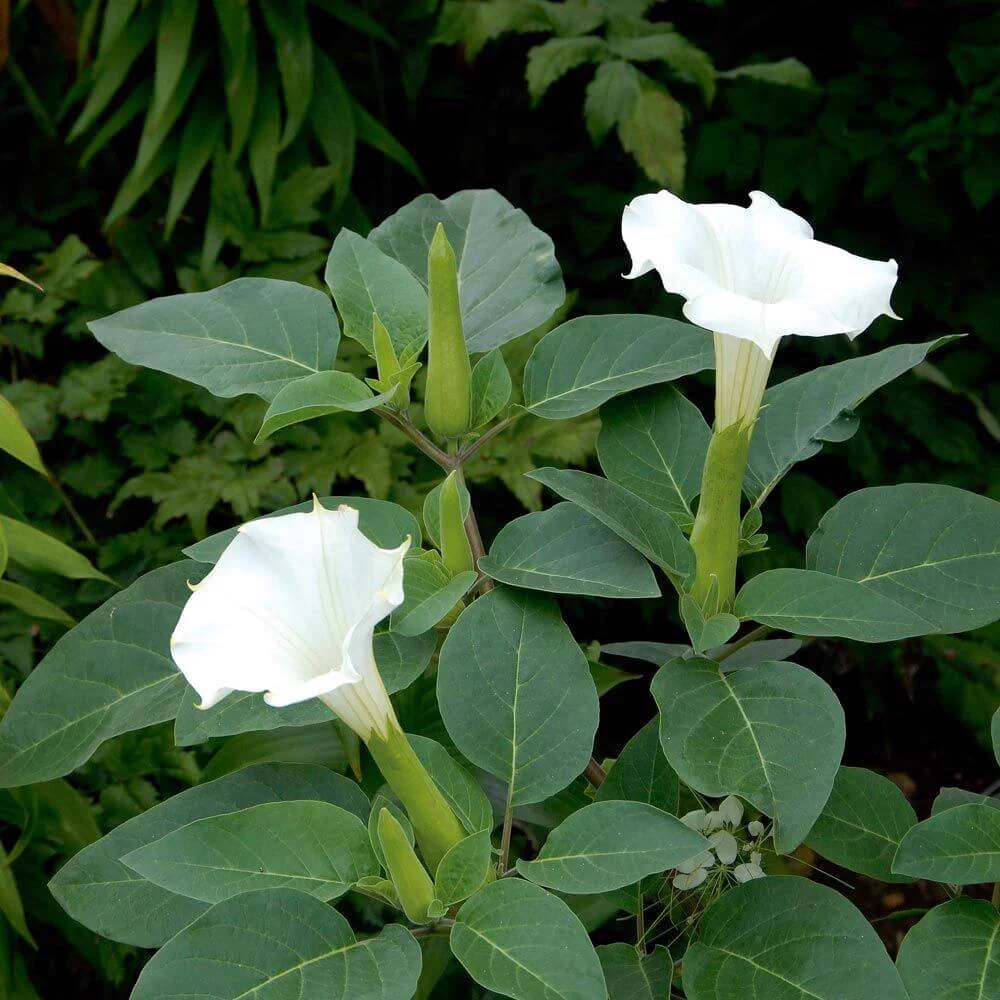
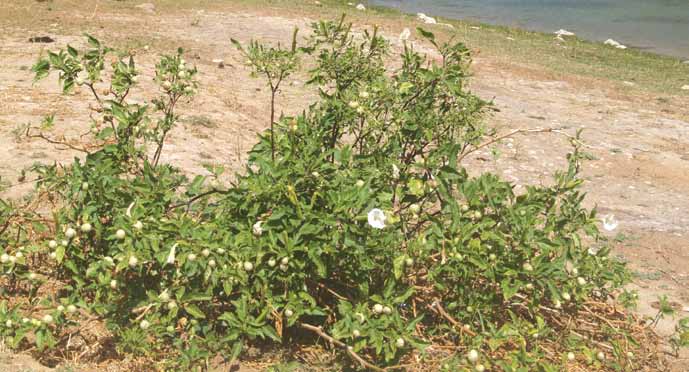
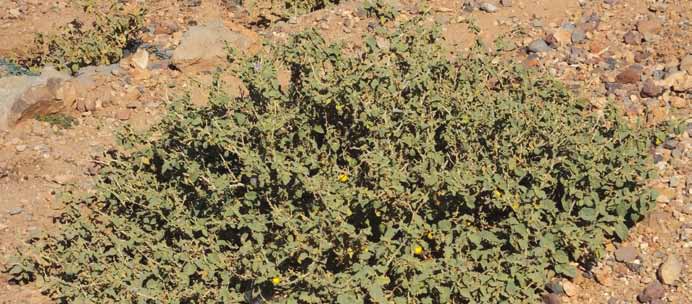
A very thorny, much-branched shrub 1-3 m tall with tangled, zigzag, grey to whitish branches; some twigs end in spines 1-2 cm long. Leaves are small, simple, somewhat fleshy, oblong-spathulate to linear, clustered on short spurs. Flowers are solitary, narrowly tubular, about 12-16 mm long, whitish to pale violet. The fruit is a small red, sweet, many-seeded berry 3-5 mm across, eaten by people and by birds. Flowers mainly from late autumn to early summer.
Habitat
Arid and semi-arid environments, gravel plains, foothills up to 1200 m, and wadis, thriving in sandy or gravelly soils with minimal moisture. Commonly found in deserts and coastal regions.
Distribution
Eastern Mediterranean region, the Middle East and the Arabian Peninsula (including Oman) through Iran to western India; in Africa from Egypt, Sudan and Ethiopia south through East Africa to Botswana, Zimbabwe and South Africa.
Pastoral value
Good browse: the leaves and new growth are readily eaten by camels, goats and other livestock, and by gazelles.
Other uses
The ripe berries are eaten, and in parts of Africa the leaves are cooked as a vegetable. The wood is used as fuel and the thorny branches for fencing and hedges. Traditionally used in folk medicine: berries for stomach pain and colic and as a laxative, stems as a diuretic and tonic, pounded leaves for eye complaints, and preparations for sores, itching and earache.
Sources
- الدليل الحقلي المصور للنباتات البرية في سلطنة عُمان (BOOK.pdf p.187)
- PROTA (Pl@ntUse) — Lycium shawii — plantuse.plantnet.org(PROTA)
- Useful Tropical Plants — Lycium shawii — tropical.theferns.info
- eNature Qatar — Desert Thorn (Lycium shawii) — enature.qa
- Flora of Qatar — Lycium shawii — floraofqatar.com
- Wikipedia — Lycium shawii — en.wikipedia.org
- GBIF backbone — Lycium shawii (name match) — api.gbif.org