Tribulus pentandrus Forssk.
قطب، حسك، زهر، ضربس، شرش، دريس
For people
- Eaten by people
- Unknown
- Toxic to people
- Unknown
For livestock
- Grazed by livestock
- Limited fodder
- Toxic to livestock
- Unknown
Edibility and safety notes
No reliable information on human edibility or toxicity of this species was found; it is not a known food plant and should not be eaten. The Omani field guide rates it as poor grazing. Its close relative Tribulus terrestris contains steroidal saponins and nitrate and causes liver damage and photosensitivity in sheep and goats that eat a lot of it; whether T. pentandrus does the same is not documented, so heavy grazing should be treated with caution. The hard winged or spiny fruit segments can injure feet and mouths.
This guide is a hobby project, not expert advice. Never eat a wild plant, or feed it to animals, on the strength of this page alone. Read the disclaimer
Description
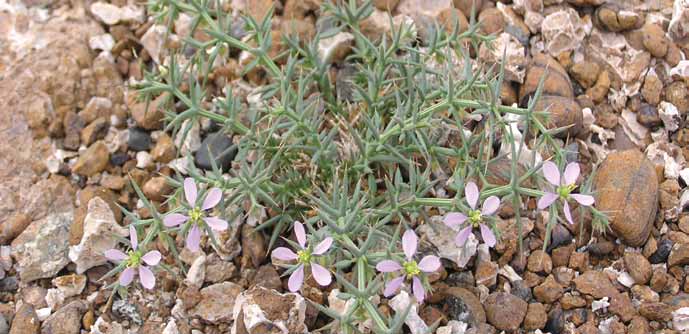
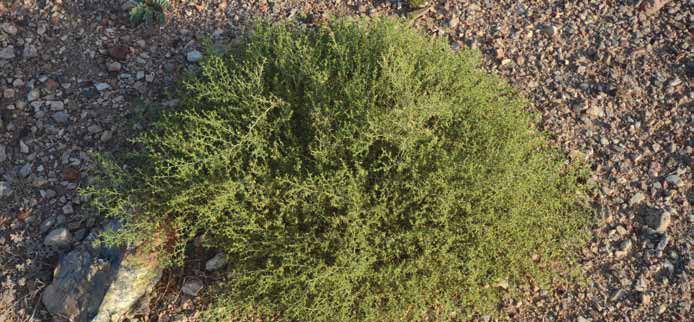
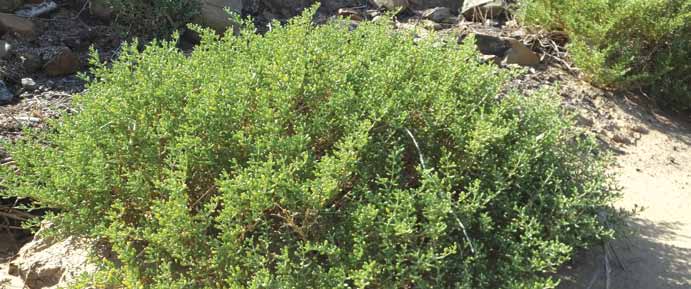
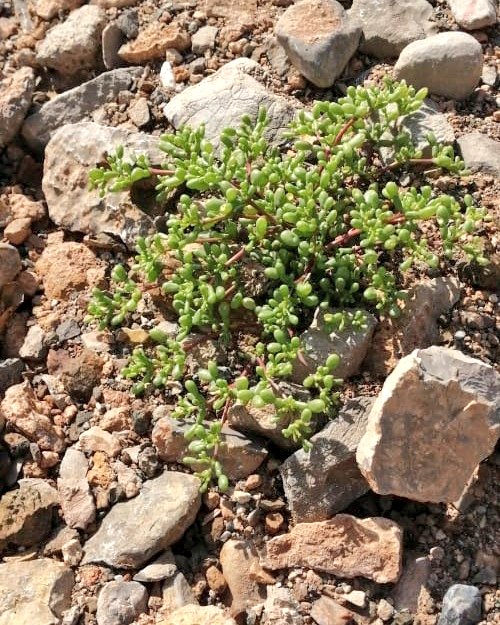
A downy annual or short-lived perennial herb, prostrate and branched from the base, with stems 20-60 cm long. Leaves pinnate, 2-7 cm long, with 3-7 pairs of small ovate-lanceolate leaflets; stipules 5-6 mm, ovate-oblong. Flowers 8-15 mm across when open, on stalks 2-6 mm long that lengthen to 1.2 cm in fruit. Sepals 5, lanceolate, 4-5 mm; petals 4.5-6 mm, yellow or white. Ovary five-chambered, with a short or absent style ending in five stigmas. Fruit pyramidal to globose, 6-12 mm across including the wings, breaking into 5 slightly hairy segments 3-8 mm across, each with two triangular wings that are entire or toothed. Flowers March-April.
Habitat
Arid and semi-arid desert regions, sandy and gravelly soils.
Distribution
Mainly Sudanian. Found in North Africa, Sinai, Palestine, Iraq, Iran, Pakistan, India, Sudan, Eritrea, Somalia, Kenya and the Arabian Peninsula.
Pastoral value
Poor grazing.
Other uses
Traditionally the plant and its spiny fruits are used as a cooling, soothing, pain-relieving, diuretic and tonic remedy, and the stems as an astringent. These are traditional uses, not medical advice.
Sources
- الدليل الحقلي المصور للنباتات البرية في سلطنة عُمان (BOOK.pdf p.200)
- Flora of Qatar — Tribulus pentandrus — floraofqatar.com
- POWO — Tribulus pentandrus Forssk. (accepted; range; Flora of Somalia description; seen in search results) — powo.science.kew.org
- Egyptian Journal of Chemistry — review of Tribulus (species variable and easily confused; search result) — ejchem.journals.ekb.eg
- University of Arizona Extension — Toxic plant: Puncturevine/Goathead (genus toxicity context; search result) — extension.arizona.edu