Tetraena qatarensis (Hadidi).Beier & Thulin
هرم
For people
- Eaten by people
- Not edible
- Toxic to people
- Unknown
For livestock
- Grazed by livestock
- Limited fodder
- Toxic to livestock
- Unknown
Edibility and safety notes
Not a food plant: regional sources (Qatar eNature, Flora of Qatar) state it is not edible for people; the leaves are only used in folk medicine, and the Omani book itself warns that taking much of it upsets the urinary system. Livestock usually avoid this salty succulent shrub; it gives some summer or post-drought grazing for camels and goats but is considered unhealthy for animals in excess. No reliable data on its toxicity to people were found, so do not eat it.
This guide is a hobby project, not expert advice. Never eat a wild plant, or feed it to animals, on the strength of this page alone. Read the disclaimer
Description
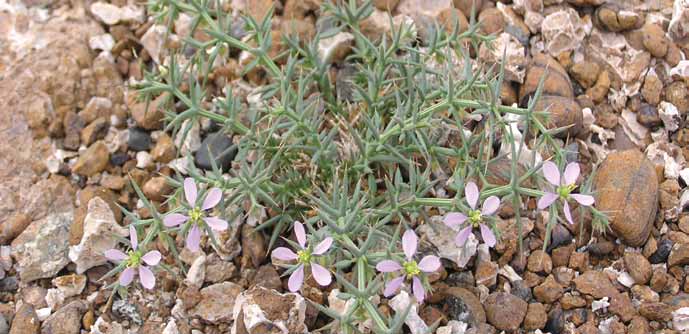
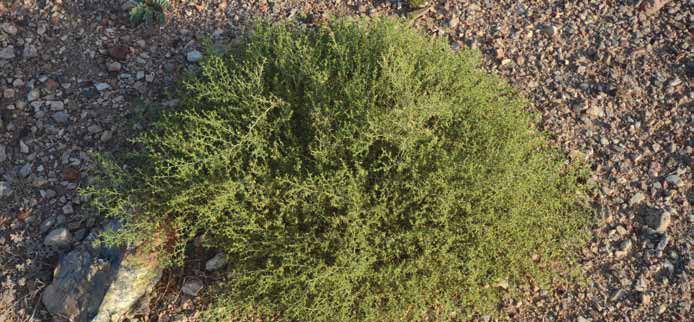
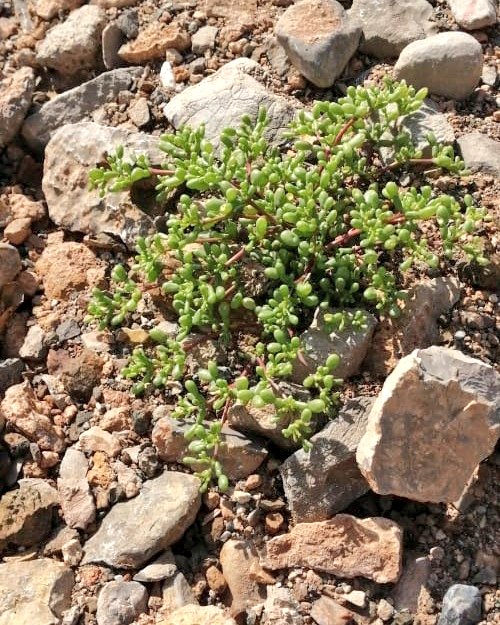
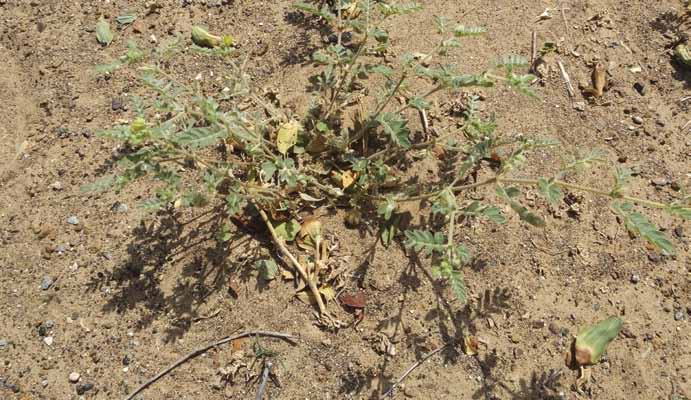
A perennial succulent dwarf shrub 20-40 cm tall, covered with short grey hairs when young and becoming green and hairless later. Stems numerous, much branched, woody at the base; branches erect or ascending, whitish, opposite, long but unequal. Leaves with two leaflets; stipules broad, fused at the base, membranous, triangular, pointed; petiole fleshy and longer than the leaflets. Leaflets 1-3 cm, fleshy, oblong or cylindrical, entire. Flowers solitary at the ends of young branches. Sepals 5, 5-6 mm, shorter than the pedicel, ovate with a membranous margin, forming a hood. Petals 5, 8-10 mm, white or pink, spoon-shaped, pointed, with a long claw. Stamens 10, with scales at the base of the filaments as long as the ovary; ovary superior, 5-chambered, hairless. Fruit an erect capsule 8-10 mm long, cylindrical to five-angled, truncate at the tip, with a short style. Seeds compressed, ovate, pointed, with a wrinkled-tuberculate surface. Flowers mainly March-May.
Habitat
Hot deserts, on rocky, gravelly and often saline soils; also coastal sands, gravel plains and the edges of sabkha (salt flats).
Distribution
Saharo-Arabian. Endemic to the Arabian Peninsula: eastern Saudi Arabia, Kuwait, Bahrain, Qatar, the UAE, Oman, Yemen and Socotra, extending to Iraq.
Pastoral value
Poor grazing; browsed after drought. Usually avoided by livestock, but gives some summer grazing for camels and goats; considered unhealthy for animals in excess.
Other uses
Traditionally the fresh leaves are chewed for diabetes and to reduce thirst, with the caution that taking too much upsets the urinary system; an infusion of the plant drunk in the morning is used for abdominal bloating. The ripening and dried fruits and seeds are also used. Other traditional uses include rheumatism, joint pain and swelling, asthma and as a diuretic. For earache the washed plant is wrapped in cloth and squeezed, and the mucilaginous juice is dropped into the ear. These are traditional uses, not medical advice.
Sources
- كتاب نباتات عمان
- eNature Qatar — Harm (Tetraena qatarensis) — enature.qa
- Flora of Qatar — Zygophyllum qatarense — floraofqatar.com
- UAE National Red List — Tetraena qatarensis (LC, 2019) — nationalredlist.org
- GBIF species match — Tetraena qatarensis — api.gbif.org
- POWO — Zygophyllum qatarense Hadidi (search result; native to Gulf States, Kuwait, Oman, Saudi Arabia, Socotra, Yemen) — powo.science.kew.org