Ocimum forskaolii Benth.
ريحان، ريحون، ض�أرت، الحبق
For people
- Eaten by people
- Unknown
- Toxic to people
- Unknown
For livestock
- Grazed by livestock
- Not grazed
- Toxic to livestock
- Unknown
Edibility and safety notes
This wild basil is used mainly for its scent, as a traditional remedy and as an insect repellent; in Oman no food use was found. Only one source (a Saudi study) reports it being used to flavour butter and tea, which is not enough to call it edible. The essential oil of Omani plants is very rich in estragole, a compound that food-safety agencies advise limiting, so it should not be eaten in quantity or the oil swallowed. The field guide says livestock do not graze it.
This guide is a hobby project, not expert advice. Never eat a wild plant, or feed it to animals, on the strength of this page alone. Read the disclaimer
Description
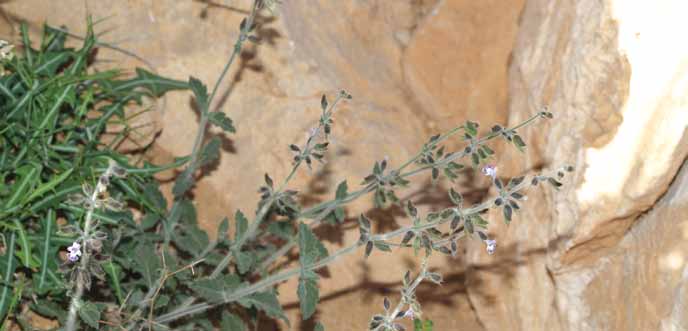
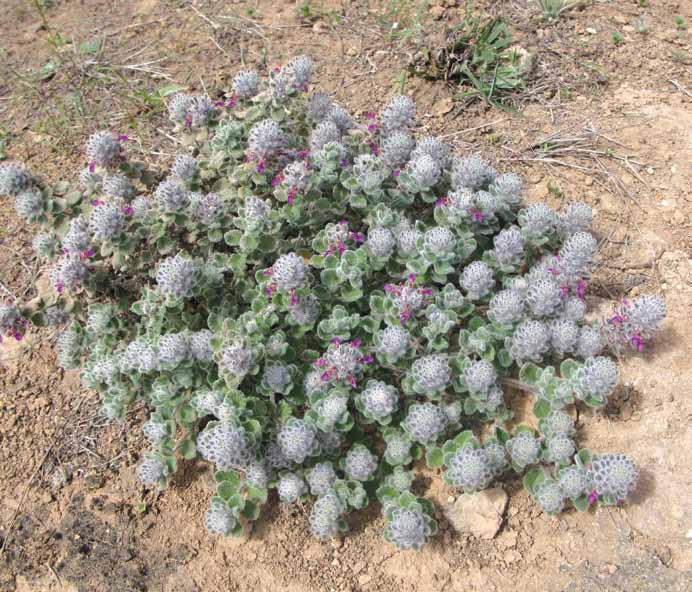
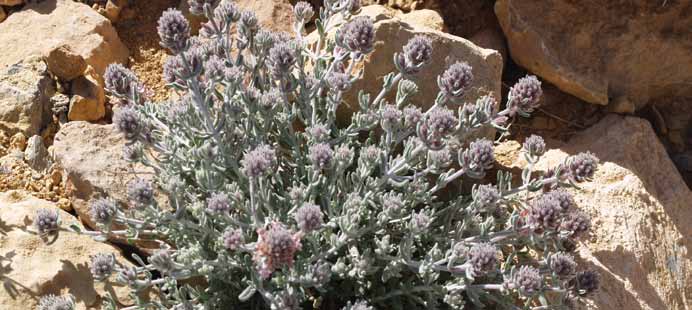
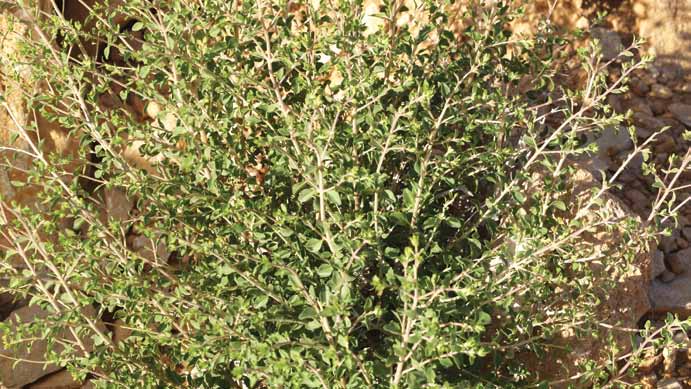
An erect, aromatic annual herb (sometimes a short-lived subshrub) 20-60 cm tall. Stems are square in section, branched and downy. Leaves are simple, opposite, stalked, ovate to lanceolate, 2-5 x 1-3 cm, with toothed or entire margins. Flowers are small, white or pink, in terminal spike-like inflorescences; calyx and corolla are two-lipped, with 4 stamens. The fruit consists of 4 small, ovoid, smooth black nutlets.
Habitat
Open places, rocky slopes, roadsides and fields.
Distribution
Egypt south to Kenya (Sudan, Eritrea, Ethiopia, Djibouti, Somalia), Angola and the Arabian Peninsula (Saudi Arabia, Yemen, Socotra, Oman, Gulf States); in Oman mainly in the south.
Pastoral value
Not grazed by livestock.
Other uses
Valued for its strong scent: a bunch is tucked behind the ear to smell through the day, and the leaves are rubbed between the hands and over the body as a perfume and deodorant. Traditionally the crushed leaves are held near the nose for fainting and nausea, and the juice is put in the nose for colds and a blocked nose. Elsewhere it is traditionally used for headache, fever and skin infections, and in Eritrea the fresh or burnt plant is used to repel mosquitoes.
Sources
- الدليل الحقلي المصور للنباتات البرية في سلطنة عُمان (BOOK.pdf p.125)
- Plants of the World Online - Ocimum forskaolii Benth. — powo.science.kew.org
- Essential oil of Forsskal's basil (Saudi Arabia) - traditional uses, PMC10057570 — pmc.ncbi.nlm.nih.gov
- Ocimum forskolei and Teucrium yemense essential oils - uses in Yemen/UAE/Eritrea, Omani oil composition, PMC5590053 — pmc.ncbi.nlm.nih.gov
- Chemotypes of Ocimum forskolei and O. basilicum (Sultan Qaboos University) — squ.elsevierpure.com
- EU Scientific Committee on Food - opinion on estragole — food.ec.europa.eu