
Prosopis cineraria (L.) Druce
الغاف، غاف
For people
- Eaten by people
- Edible
- Toxic to people
- Not toxic
For livestock
- Grazed by livestock
- Good fodder
- Toxic to livestock
- Not toxic
Edibility and safety notes
The pods are eaten by people: green or dried pods are cooked as a vegetable (the 'sangri' of Rajasthan; also used in Oman) and the sweetish pulp of ripe pods can be eaten raw. The Omani field guide also records that local people eat the leaves; this is a known Gulf custom using the tender young leaves, but it was not confirmed in the independent sources consulted. Leaves and pods are valued fodder for camels, goats, sheep and cattle; the foliage is rich in tannins, so it is best as part of a mixed diet. No poisoning is reported. Do not confuse it with the introduced mesquite (P. juliflora).
This guide is a hobby project, not expert advice. Never eat a wild plant, or feed it to animals, on the strength of this page alone. Read the disclaimer
Description
An evergreen tree growing to 6.5 m tall with bipinnate leaves and thorned branches along internodes. Small creamy-yellow flowers followed by seeds in pods. Produces a taproot over 3 m long, enabling survival in extremely arid conditions.
Habitat
Arid and semi-arid lowland tropical and subtropical areas, from sea level to 600 m. Found in extremely arid conditions with rainfall as low as 15 cm annually, indicative of deep water table presence.
Distribution
Native to western Asia and the Indian subcontinent, including Afghanistan, Bahrain, Iran, India, Oman, Pakistan, Saudi Arabia, UAE, and Yemen. National tree of the UAE.
Pastoral value
Excellent fodder tree. Leaves and pods are important livestock feed, especially during dry seasons. Pods are highly nutritious for cattle, goats, and camels.
Other uses
One of the largest wild trees in Oman. According to the Omani field guide, local people eat the leaves, and the pods are added to yoghurt for flavour or mixed with rice and fish as a salad-like side dish. In the Thar Desert the green and dried pods ('sangri') are cooked as a vegetable, and the bark was ground into flour as a famine food. The tree gives shade and shelter to wildlife, birds and insects, stabilises sand dunes, fixes nitrogen, and yields good fuelwood and charcoal. Bark, leaves, pods and flowers are used in traditional medicine. National tree of the UAE.
Sources
- الدليل الحقلي المصور للنباتات البرية في سلطنة عُمان (BOOK.pdf p.117)
- Feedipedia — Khejri (Prosopis cineraria) — feedipedia.org
- Useful Tropical Plants — Prosopis cineraria — tropical.theferns.info
- Plants of the World Online — Prosopis cineraria (L.) Druce — powo.science.kew.org
- CIHEAM Options Méditerranéennes — Ghaf (Prosopis cineraria) pods as feed for Omani sheep (Sultan Qaboos University) — ressources.ciheam.org
- Plants For A Future - Prosopis cineraria — pfaf.org
- Wikipedia - Prosopis cineraria — en.wikipedia.org
- Potential Antioxidant Effects of Common Omani Ethnobotanical Plants (PMC11699577) — pmc.ncbi.nlm.nih.gov
From the same family
All in this family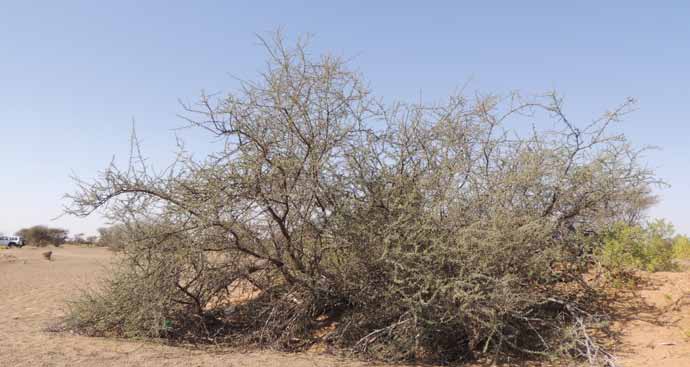
Fabaceae
Salam tree, Desert acacia
Acacia ehrenbergiana Hayne.
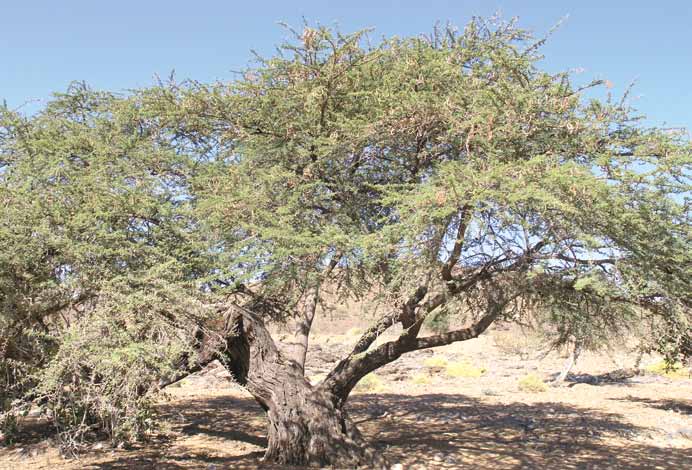
Fabaceae
Red thorn, Grey-haired acacia, Talh
Acacia gerrardii Benth.
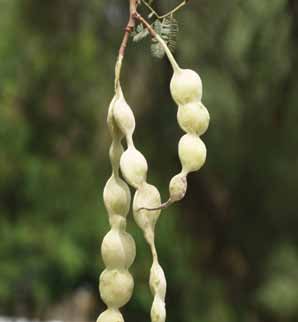
Fabaceae
Gum arabic tree, Babul, Thorn mimosa, Egyptian acacia, Thorny acacia
Acacia nilotica (L.) Del.
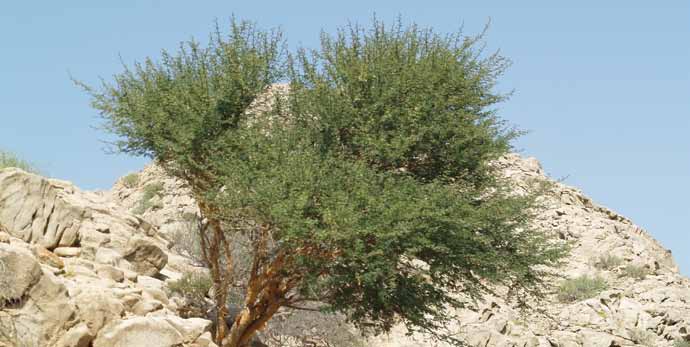
Fabaceae
Gum acacia, Gum arabic tree, Sudan gum
Acacia senegal (L.) Willd.