
Acacia ehrenbergiana Hayne.
السلم، سلم
For people
- Eaten by people
- Unknown
- Toxic to people
- Unknown
For livestock
- Grazed by livestock
- Good fodder
- Toxic to livestock
- Not toxic
Edibility and safety notes
No human food use is documented: Useful Tropical Plants lists edible uses as 'none known', and the trunk gives only a low-quality gum. It is an important browse for camels, goats and sheep, which eat the leaves, flowers and pods. Acacia foliage is high in tannins and some acacias can build up cyanide-forming compounds in drought, so it is animal feed, not human food.
This guide is a hobby project, not expert advice. Never eat a wild plant, or feed it to animals, on the strength of this page alone. Read the disclaimer
Description
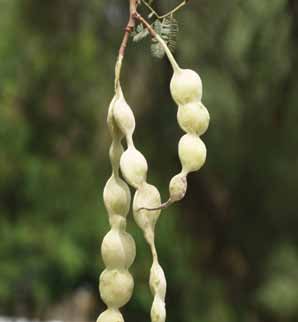
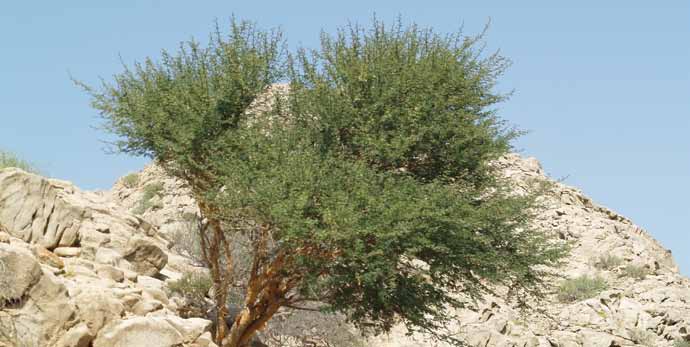
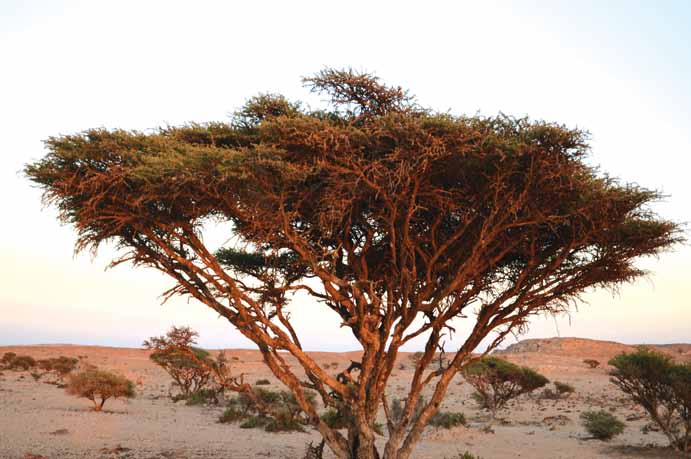
A drought-resistant shrub or small multi-stemmed tree growing 2-6 metres tall with smooth, shining chestnut-brown branches. It has white thorns, small leaves with 1-2-jugate pinnae and 8-10-jugate oblong leaflets, and produces yellow flowers.
Habitat
Dry semi-desert areas on sandy soils, sand dunes, dry river valleys and slopes. Very tolerant of low rainfall, able to grow with only 50mm rainfall per year on sandy soils.
Distribution
Sahara, northern Sahel, East Africa, the Arabian Peninsula (including Oman) and Iran; from Morocco to Senegal, east to Sudan and Ethiopia.
Pastoral value
Important browse species for goats, sheep and camels, especially in arid regions. Produces high quality honey.
Other uses
The stems and branches are used for charcoal and firewood. A sticky tar is extracted and traditionally applied to fungal skin infections and insect stings in animals, also to human skin, and used to coat wooden vessels. The tree is planted to stabilise sand dunes. The bark yields rope fibre, the trunk a low-quality gum, and the flowers are a source of honey.
Sources
- الدليل الحقلي المصور للنباتات البرية في سلطنة عُمان (BOOK.pdf p.100)
- Useful Tropical Plants - Vachellia flava (syn. Acacia ehrenbergiana) — tropical.theferns.info
- Wikipedia - Vachellia flava — en.wikipedia.org
- POWO - Acacia ehrenbergiana Hayne — powo.science.kew.org
From the same family
All in this family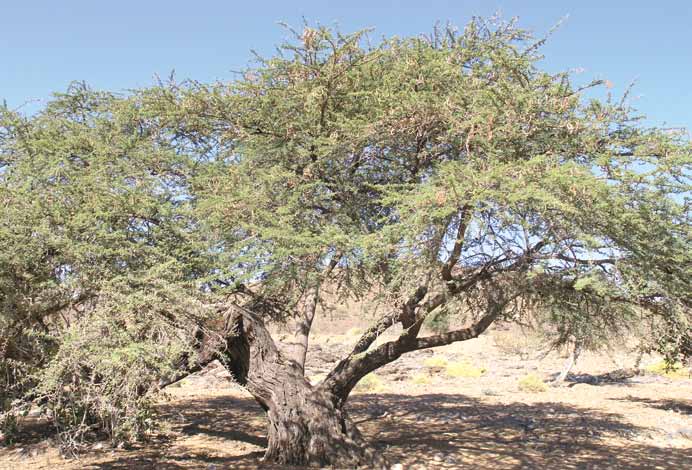
Fabaceae
Red thorn, Grey-haired acacia, Talh
Acacia gerrardii Benth.
Fabaceae
Gum arabic tree, Babul, Thorn mimosa, Egyptian acacia, Thorny acacia
Acacia nilotica (L.) Del.
Fabaceae
Gum acacia, Gum arabic tree, Sudan gum
Acacia senegal (L.) Willd.
Fabaceae
Umbrella thorn, Umbrella thorn acacia, Israeli babool
Acacia tortilis (Forssk.) Hayne.