Pulicaria glutinosa (Boiss.) Jaub. & Spach
مهتدي، شجرة فال
For people
- Eaten by people
- Unknown
- Toxic to people
- Unknown
For livestock
- Grazed by livestock
- Unknown
- Toxic to livestock
- Unknown
Edibility and safety notes
Not a food plant. The Omani field guide records the leaves being drunk as a tea for stomach complaints, and heated leaf juice is rubbed on rheumatic joints, but these are folk-medicine uses and no study of its safety for people was found, so it should not be eaten or drunk on the strength of this guide. Sources disagree on grazing: the field guide says it is not grazed, while an Omani newspaper says animals feed on it; no livestock poisoning reports were found.
This guide is a hobby project, not expert advice. Never eat a wild plant, or feed it to animals, on the strength of this page alone. Read the disclaimer
Description
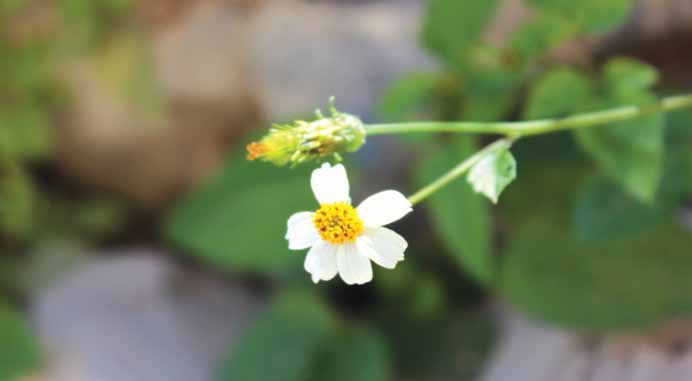
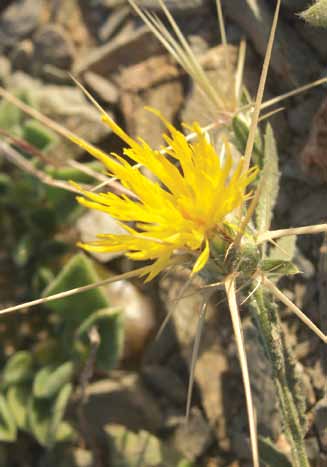
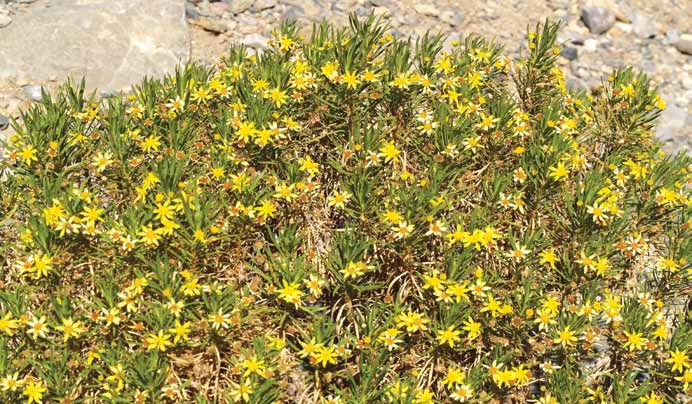
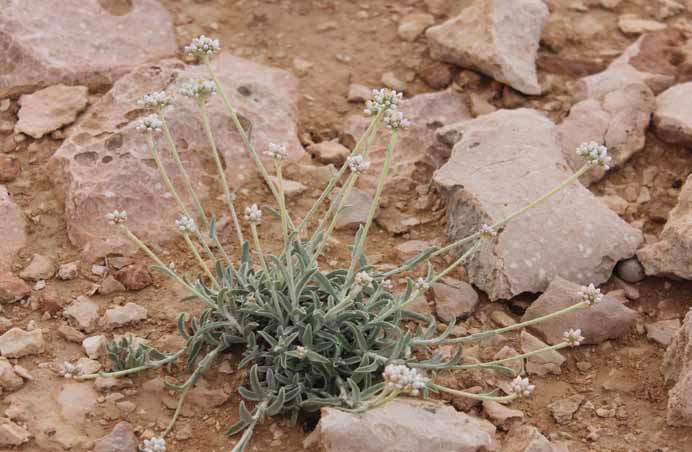
Densely branched, aromatic, glabrous and sticky shrublet, usually up to about 30 cm tall. Leaves linear, 10-35 x 1-2 mm, with strongly down-rolled margins and a short pointed tip, glabrous and sticky. Flower heads terminal and solitary on stalks 1-3 cm long; involucre 5-8 mm long, its bracts lanceolate, acute to pointed, brown to violet in the middle. Corollas yellow; the marginal florets are female and resemble the central tubular florets, which are 4-6 mm long with glandular lobes. Achene about 1.5 mm long, 10-ribbed, downy; outer pappus of 10-12 partly united scales 0.5-1 mm long, inner pappus of numerous bristles about 5 mm long.
Habitat
Widespread on flat sandy and stony ground, gravel plains, wadis and mountain slopes.
Distribution
Native to northeastern tropical Africa, the Arabian Peninsula, and southern Pakistan.
Pastoral value
Not grazed according to the Omani field guide, although an Omani newspaper report says animals feed on it.
Other uses
Traditionally the leaves are taken as a tea for stomach complaints, and in Oman heated leaf juice is rubbed on joints for rheumatism and used for skin complaints. Also reported as a source of yellow dye. These are folk uses, not medical advice.
Sources
- الدليل الحقلي المصور للنباتات البرية في سلطنة عُمان (BOOK.pdf p.45)
- Oman Observer — Al Muhtadi: plants that can tolerate dry conditions — omanobserver.om
- UAE National Red List — Pulicaria glutinosa — nationalredlist.org
- Plants of the World Online — Pulicaria glutinosa (Boiss.) Jaub. & Spach — powo.science.kew.org
- A critical review on Pulicaria species occurring in Qatar: traditional uses, phytochemistry and biological activities (record) — asren-aggregator.asren.net