Teucrium stocksianum Boiss.
الجعدة، يعدة
For people
- Eaten by people
- Not edible
- Toxic to people
- Unknown
For livestock
- Grazed by livestock
- Not grazed
- Toxic to livestock
- Unknown
Edibility and safety notes
Not a food plant: it is a bitter aromatic herb taken only as a medicinal infusion or decoction (the Omani book also mentions flavouring tea). Abu Dhabi health authority sources say its safety is not established, advise against oral use in pregnancy, breastfeeding and children, and note that related germanders have caused hepatitis and deaths; rat studies of this species showed raised liver enzymes and deaths at high repeated doses and a possible effect on the nervous system. Avoid regular or heavy use. Livestock do not graze it.
This guide is a hobby project, not expert advice. Never eat a wild plant, or feed it to animals, on the strength of this page alone. Read the disclaimer
Description
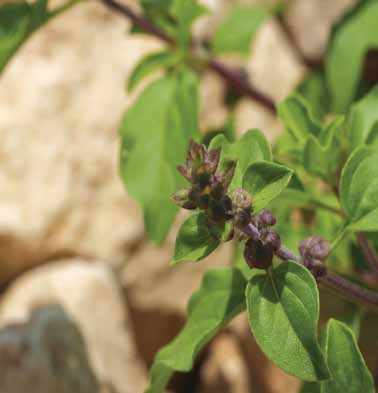
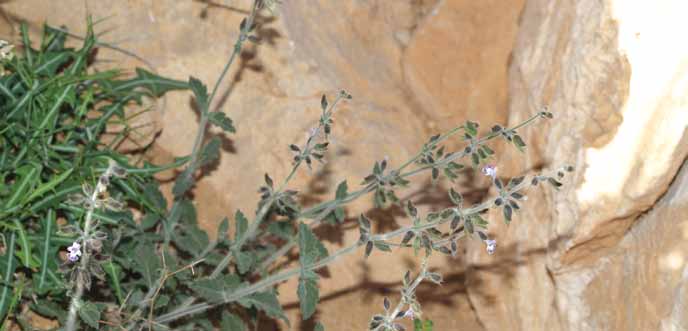
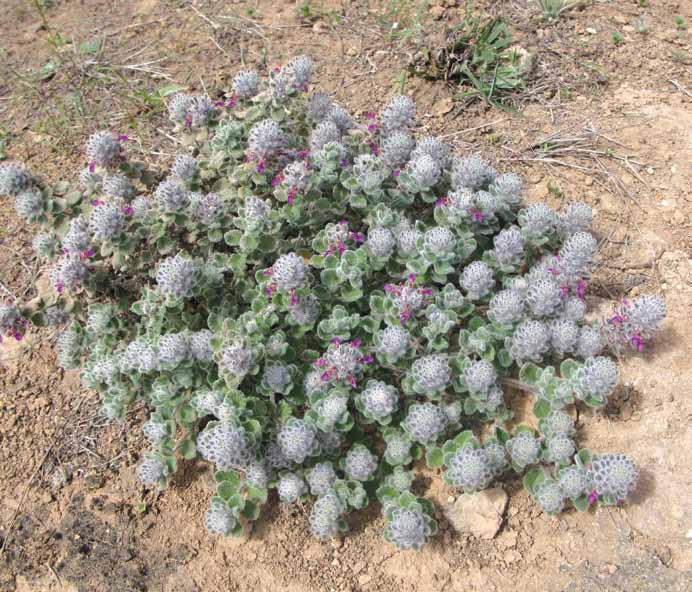
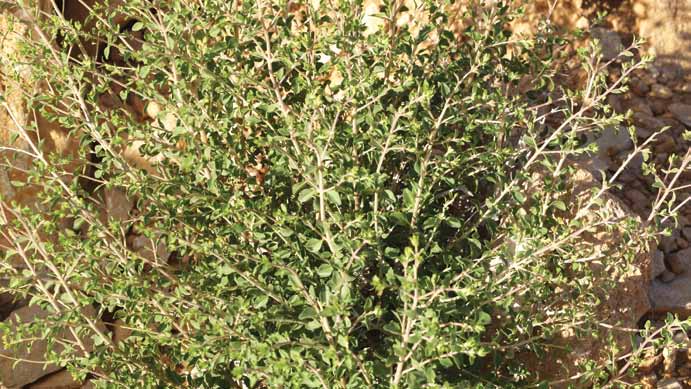
An aromatic perennial herb with a woody base. Stems simple or branched, 10-30 cm long, leafy, whitish to grey, covered with short hairs. Leaves grey-white, narrowly elliptic, oblong or obovate, stalkless or nearly so, about 5-20 mm long and 2-10 mm wide, wedge-shaped at the base, toothed or lobed in the upper part to almost entire, densely hairy on both sides and dotted with stalkless oil glands. Flowers stalkless, crowded in ovoid terminal or lateral heads, with leaf-like oblong to linear bracts as long as or longer than the calyces. Calyx bell-shaped to tubular, hairy, 5-7 mm long. Corolla white to cream or pale pink with darker pink veins, 8-14 mm long. Stamens 4. Fruit of 4 wrinkled-reticulate nutlets about 2 mm long. Flowers mainly January-May.
Habitat
Rocky and stony mountain areas, hillsides, slopes and wadis (Hajar mountains), from near sea level to about 2000 m.
Distribution
South-eastern Arabia (northern Oman including Musandam, the UAE, Saudi Arabia), Iran, Afghanistan and Pakistan.
Pastoral value
Not grazed by livestock.
Other uses
An aromatic plant traditionally added to tea and used as a flavouring. In traditional medicine an infusion is used for flatulence and rheumatism and as an insect repellent, and a decoction of the leaves for stomach pain, headache, renal colic, colds and fever, diabetes and malaria; it has also been used for smallpox, nervous complaints, spasms and intestinal worms. In Oman the washed plant is boiled with a little water and dried lime, strained and drunk when needed. These are traditional uses, not medical advice; the safety of the plant is not established.
Sources
- الدليل الحقلي المصور للنباتات البرية في سلطنة عُمان (BOOK.pdf p.128)
- Abu Dhabi DoH Encyclopedia of Medicinal Plants of UAE — Teucrium stocksianum — medicinalplants.doh.gov.ae
- Abu Dhabi DoH public leaflet — Teucrium stocksianum (safety advice) — medicinalplants.doh.gov.ae
- King, R.A. (1988) Studies in the Flora of Arabia XIX: Teucrium in the Arabian Peninsula and Socotra. Notes RBG Edinburgh 45(1) — journals.rbge.org.uk
- Tanira et al. 1996 — Toxicological effects of Teucrium stocksianum after acute and chronic administration in rats (abstract record) — acnpsearch.tweb-dev.unibo.it
- PMC — Phytochemicals, antioxidant, antinociceptive and anti-inflammatory potential of Teucrium stocksianum (search result) — pmc.ncbi.nlm.nih.gov