Salvia aegyptiaca L.
رعل، مرميية، الخافية، خزام، غبيشة، شجرة الغزال، بشارى
For people
- Eaten by people
- Unknown
- Toxic to people
- Unknown
For livestock
- Grazed by livestock
- Limited fodder
- Toxic to livestock
- Unknown
Edibility and safety notes
No reliable information on the edibility of this small desert sage as food was found; it is known only as a folk-medicine plant (used traditionally for diarrhoea and stomach complaints), which does not make it a food. No poisoning of people or animals is documented in the sources consulted, but its safety has not been positively established either. The book rates it as poor grazing for livestock.
This guide is a hobby project, not expert advice. Never eat a wild plant, or feed it to animals, on the strength of this page alone. Read the disclaimer
Description
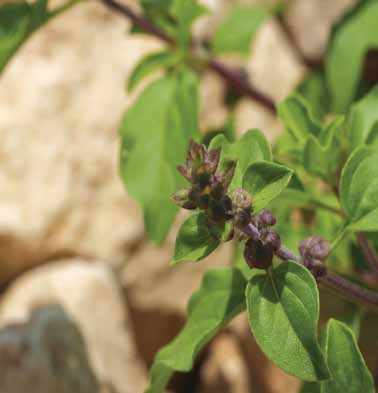
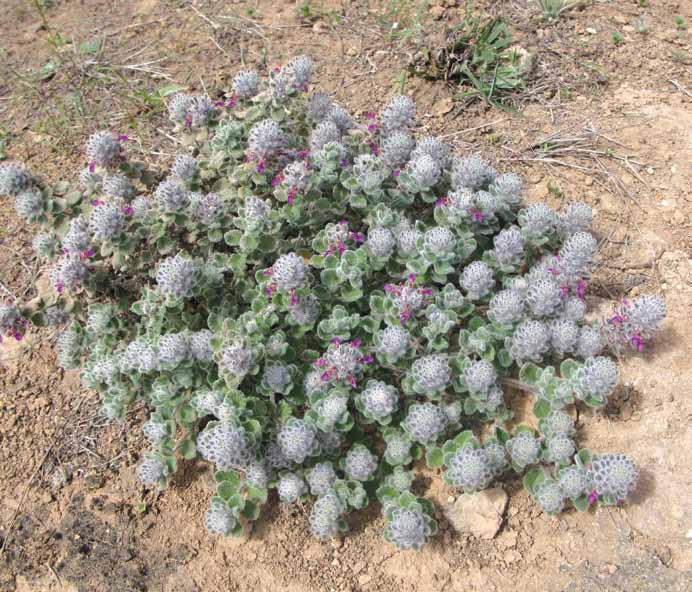
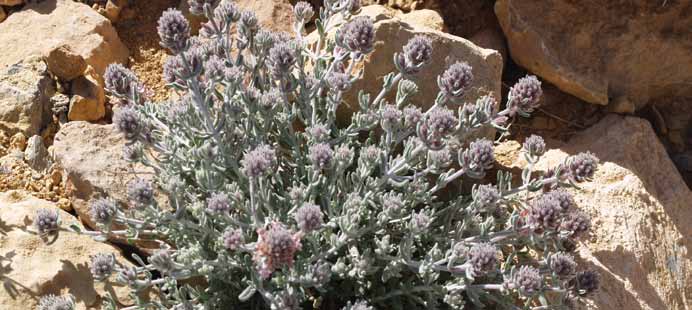
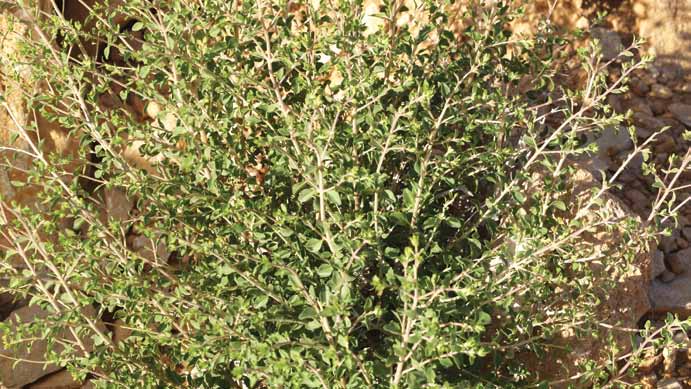
A small, densely branched subshrub 10–40 cm tall, hard and woody at the base, covered with silvery down and with glandular and non-glandular hairs. Branches prostrate or ascending, intricate, stiff and forked. Leaves narrowed at the base into a short stalk, oblong to linear, pointed, 10–25 mm long and 2–5 mm wide, with a rough, wrinkled surface and toothed, inrolled margins. Flowers in distant whorls of 2–6 forming a raceme-like inflorescence, nodding on short stalks. The calyx is purplish, two-lipped and hairy, 3–4 mm long in flower and 5–7 mm in fruit. The corolla is pale blue to blue-violet or whitish, about one and a half times as long as the calyx, with the upper lip shorter than the lower. The fruit consists of four nutlets. Flowers from February to May.
Habitat
Desert wadi beds, sandy and gravelly plains, and rocky and mountain slopes up to about 2000 m; tolerant of heat and drought.
Distribution
Mainly Saharo-Arabian, extending into the Sudanian region: Cape Verde and Canary Islands, North and north-west Africa, Sudan, Ethiopia, the eastern Mediterranean, the Arabian Peninsula, Iran, Afghanistan, Pakistan and India. In Oman it occurs in the north.
Pastoral value
Poor grazing value.
Other uses
Traditionally used in folk medicine for diarrhoea, gonorrhoea and haemorrhoids, and as a demulcent, antispasmodic, wound-healing, antiseptic and stomachic remedy. These are traditional uses, not medical advice.
Sources
- الدليل الحقلي المصور للنباتات البرية في سلطنة عُمان (BOOK.pdf p.126)
- Wikipedia — Salvia aegyptiaca — en.wikipedia.org
- Flora of Qatar — Salvia aegyptiaca — floraofqatar.com
- GBIF species match — Salvia aegyptiaca L. — api.gbif.org
- GBIF occurrences in Oman — Salvia aegyptiaca — api.gbif.org