Cornulaca aucheri Moq.
حسلي، الحاذ
For people
- Eaten by people
- Unknown
- Toxic to people
- Unknown
For livestock
- Grazed by livestock
- Limited fodder
- Toxic to livestock
- Not toxic
Edibility and safety notes
No record was found of people eating this plant and nothing reliable on toxicity to people, so it should not be eaten. It is a spiny desert plant: leaves and bracts end in sharp spines that can injure skin. It is a traditional camel fodder despite the spines; the Omani field guide lists it as grazed by camels only, and no report of livestock poisoning was found.
This guide is a hobby project, not expert advice. Never eat a wild plant, or feed it to animals, on the strength of this page alone. Read the disclaimer
Description
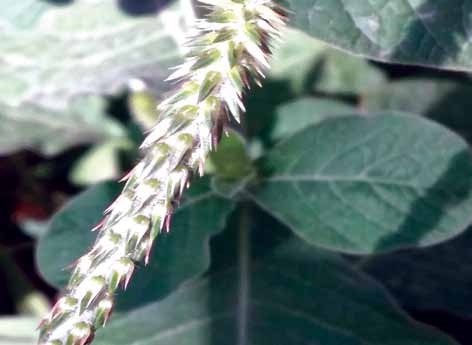
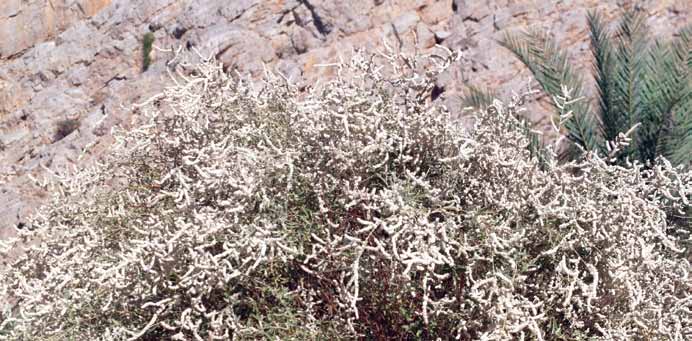
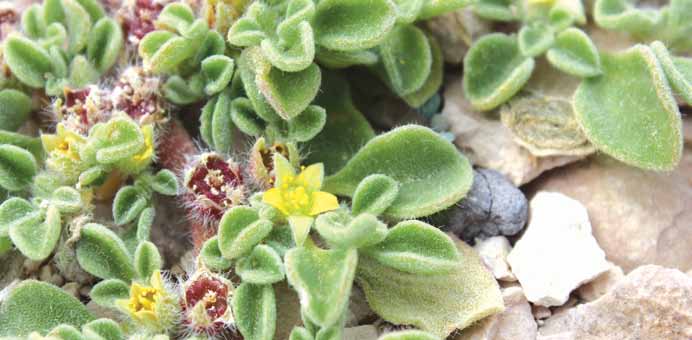
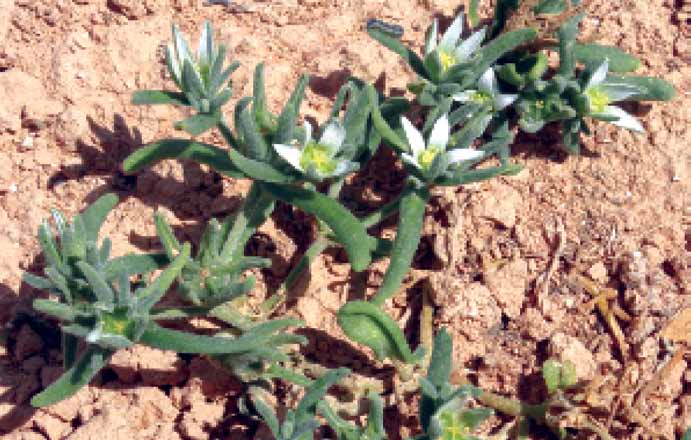
An annual or short-lived perennial, 10-30 cm tall, succulent and branched from base. Leaves are linear-filiform to triangular-subulate, 4-10 mm long, recurved, greyish-green with a white spine and densely woolly axils. Flowers engulfed in white hairs. Forms tumbleweeds when dried.
Habitat
Grows in sandy dunes and coastal areas in desert or dry shrubland biomes. Tolerates high salinity and drought.
Distribution
Native from northeast Niger to southwest Pakistan. Found in Afghanistan, Gulf States, Iran, Iraq, Kuwait, Lebanon, Syria, Libya, Oman, Saudi Arabia and Turkey.
Pastoral value
Grazed by camels, despite its spines.
Other uses
No traditional uses for people were found. The plant traps windblown sand and has been studied in Kuwait for its role in stabilising degraded sandy soils.
Sources
- الدليل الحقلي المصور للنباتات البرية في سلطنة عُمان (BOOK.pdf p.79)
- Wikipedia — Cornulaca aucheri (citing POWO, Flora of Qatar, UAE Flora) — en.wikipedia.org
- Flora of Qatar — Cornulaca aucheri — floraofqatar.com