Cornulaca monacantha Del.
الحاذ، سلى، تلع، رمرام
For people
- Eaten by people
- Unknown
- Toxic to people
- Unknown
For livestock
- Grazed by livestock
- Limited fodder
- Toxic to livestock
- Not toxic
Edibility and safety notes
No record was found of people eating this plant as food, so it should not be eaten; a leaf decoction is a traditional purgative and remedy, which is folk medicine and not a sign that it is safe. Every leaf ends in a stiff spine that can injure skin. It is good grazing for camels, especially in summer, and is said to increase their milk, but sheep and goats find it unpalatable because of the spines. No report of livestock poisoning was found.
This guide is a hobby project, not expert advice. Never eat a wild plant, or feed it to animals, on the strength of this page alone. Read the disclaimer
Description
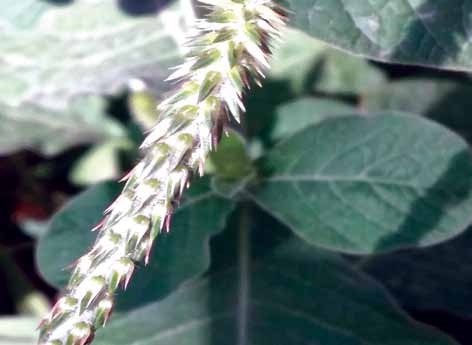
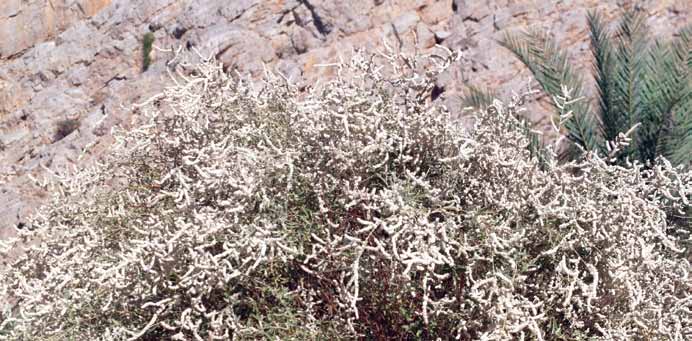
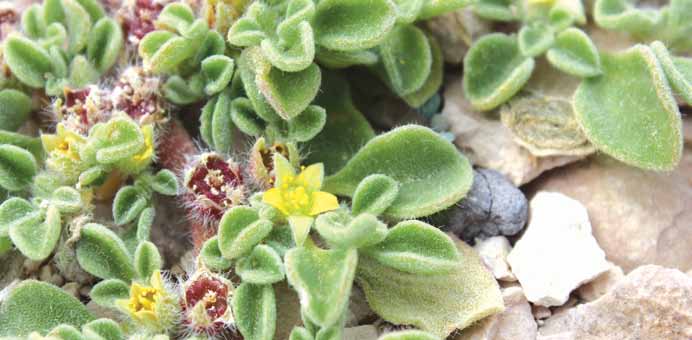
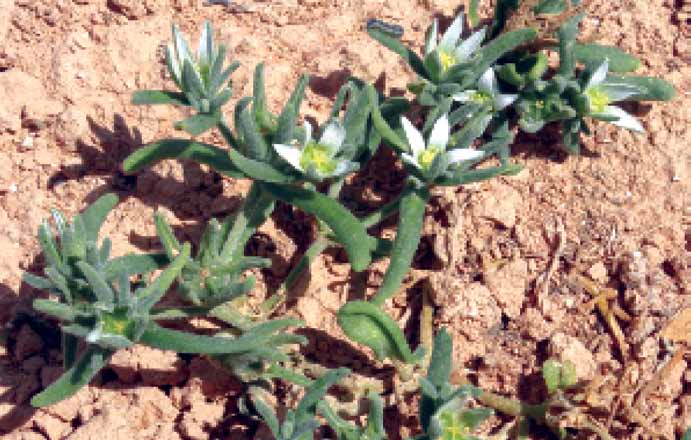
A straggling, branched, woody shrub growing to 60 cm. Stubby bluish-green leaves are scale-like and clasp the greyish wiry stems, each with a single stiff spine at the tip. Orange-brown flowers appear singly in woolly leaf axils between August and November.
Habitat
Desert plant growing in arid conditions on sandy and stony ground, sand dunes and sandy depressions. Does not grow in saline locations.
Distribution
Native to North Africa, Arabia, the Middle East, Iran and Baluchistan. Its southern range boundary in Africa defines the southern limit of the Sahara Desert.
Pastoral value
Its presence is regarded as an indicator of rangeland degradation, as it is poorly palatable to small ruminants. It is, however, a good grazing plant for camels, especially in summer, and is said to increase the milk yield of she-camels.
Other uses
A decoction of the leaves is traditionally used for jaundice and liver complaints and as a purgative, and the plant is applied externally against scabies. These are traditional uses, not medical advice.
Sources
- الدليل الحقلي المصور للنباتات البرية في سلطنة عُمان (BOOK.pdf p.80)
- Wikipedia — Cornulaca monacantha — en.wikipedia.org
- Flora of Qatar — Cornulaca monacantha — floraofqatar.com
- AGRIS/FAO — Activités alimentaires journalières de la chamelle gestante dans son milieu naturel (camel grazing study, Sahara) — agris.fao.org
- Desert Ecosystem Engineering Journal — preference value of range plants for sheep and goats (Cornulaca monacantha reduced by thorns) — deej.kashanu.ac.ir