
Heliotropium bacciferum Forssk.
رمرام
For people
- Eaten by people
- Not edible
- Toxic to people
- Toxic
For livestock
- Grazed by livestock
- Limited fodder
- Toxic to livestock
- Toxic
Edibility and safety notes
Not a food plant: like other heliotropes it contains pyrrolizidine alkaloids (confirmed in Qatar material), which damage the liver with repeated intake, so it should not be eaten or taken as a home remedy. Traditional uses are external only. The Omani field guide lists it as not grazed; Saharan sources report camels and other livestock browsing it, but the alkaloids can cause cumulative liver damage in animals that eat it regularly.
This guide is a hobby project, not expert advice. Never eat a wild plant, or feed it to animals, on the strength of this page alone. Read the disclaimer
Description
An evergreen, much-branched subshrub 20-50 cm tall, woody at the base and covered with short, appressed white hairs. Leaves simple, alternate, ovate to oblong (narrowly lance-shaped with wavy margins in Gulf material), 1-3 x 0.5-1.5 cm, grey-green. Inflorescence a scorpioid (coiled) cyme, terminal and axillary. Flowers small, white. Calyx 5-lobed, persistent. Corolla tubular, 5-lobed. Stamens 5. Ovary superior. Fruit of 4 spherical nutlets, smooth or warty.
Habitat
Dry sahel areas, coastal and inland sabkha environments in desert and semi-arid regions.
Distribution
Native from northeastern Africa to northwestern India, including Mauritania, Senegal, Mali, northern Nigeria, North Africa, Arabia, and tropical Asia. Also found in Comoros and southwestern Madagascar.
Pastoral value
Listed as not grazed in the Omani field guide. Saharan sources report that camels and other livestock browse it, but the plant contains liver-damaging pyrrolizidine alkaloids.
Other uses
Sap applied as burn ointment. Dried powdered leaves used for ringworm treatment. Used medicinally for headache, gonorrhoea, and to increase lactation. Plant macerate prepared as ink in western Sahara.
Sources
- الدليل الحقلي المصور للنباتات البرية في سلطنة عُمان (BOOK.pdf p.56)
- Plants of the World Online — Heliotropium bacciferum Forssk. — powo.science.kew.org
- Flora of Qatar — Heliotropium bacciferum — floraofqatar.com
- Useful Tropical Plants — Heliotropium ramosissimum (PROTA-based account; synonym) — tropical.theferns.info
- Occurrence of pyrrolizidine alkaloids in Heliotropium bacciferum Forssk. (Qatar University repository) — quspace.qu.edu.qa
- Herbiguide — Common Heliotrope (pyrrolizidine alkaloid toxicity in livestock) — herbiguide.com.au
- Pl@ntUse PROTA: Heliotropium ramosissimum (covers H. bacciferum) — plantuse.plantnet.org(PROTA)
- Wikipedia: Heliotropium — en.wikipedia.org
- IVIS Guide to Poisonous Plants: Heliotropium species — ivis.org
From the same family
All in this family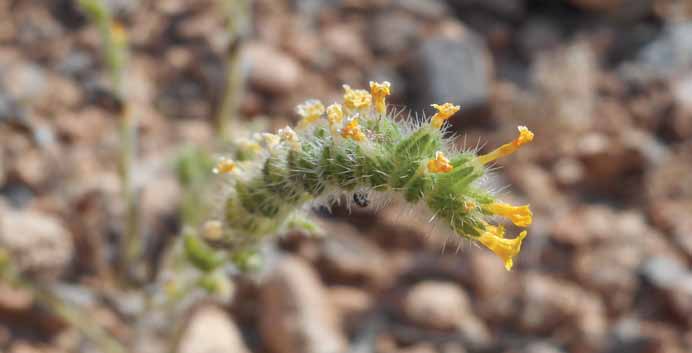
Boraginaceae
Arabian primrose
Arnebia decumbens (Vent.) Coss. & Kralik
Boraginaceae
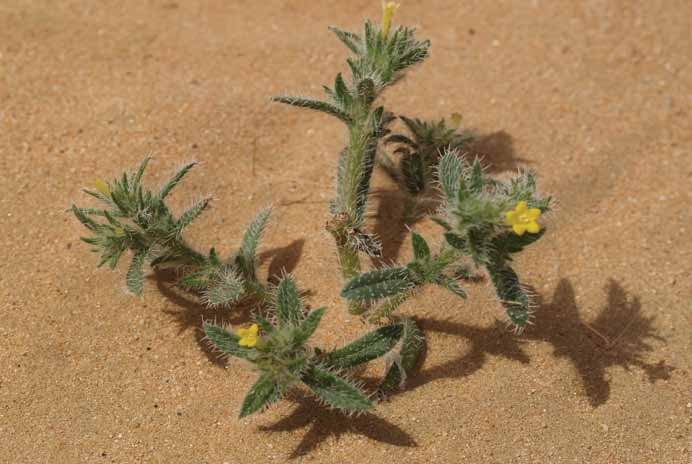
Rough arnebia, Hispid arnebia
Arnebia hispidissima (Lehm.) A.DC.
Boraginaceae
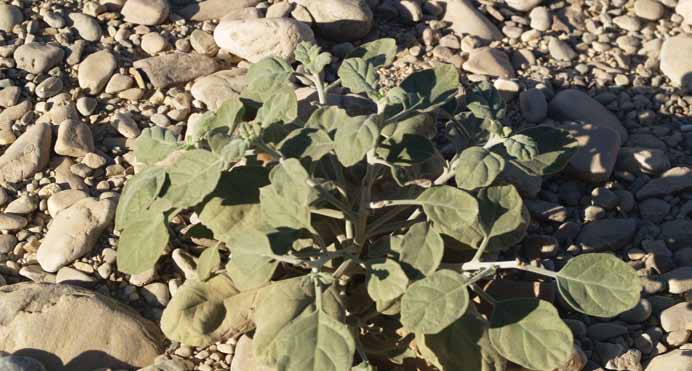
European Heliotrope, European Turn-sole
Heliotropium europaeum L.
Boraginaceae
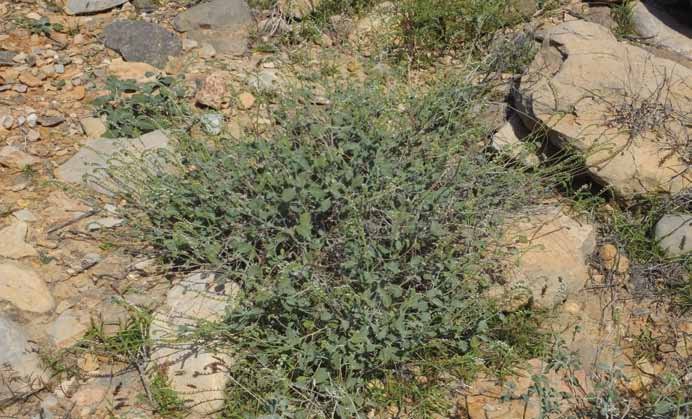
Long-flowered Heliotrope
Heliotropium longiflorum (A.DC.) Jaub. & Spach