Heliotropium longiflorum (A.DC.) Jaub. & Spach
هبليم، هيبغ، شربم
For people
- Eaten by people
- Unknown
- Toxic to people
- Unknown
For livestock
- Grazed by livestock
- Good fodder
- Toxic to livestock
- Unknown
Edibility and safety notes
No reliable information was found on people eating this plant, and it should not be eaten or taken as a home remedy: heliotropes as a genus contain pyrrolizidine alkaloids that cause cumulative liver damage, although this species itself has not been tested in any source found. The Omani field guide rates it as good grazing, but no second source confirms this, and other heliotropes have poisoned livestock that ate them over long periods.
This guide is a hobby project, not expert advice. Never eat a wild plant, or feed it to animals, on the strength of this page alone. Read the disclaimer
Description
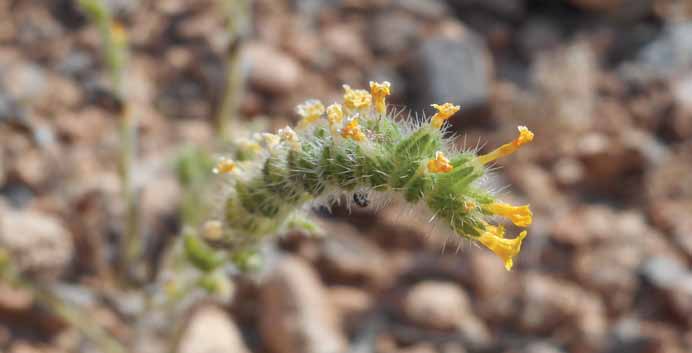
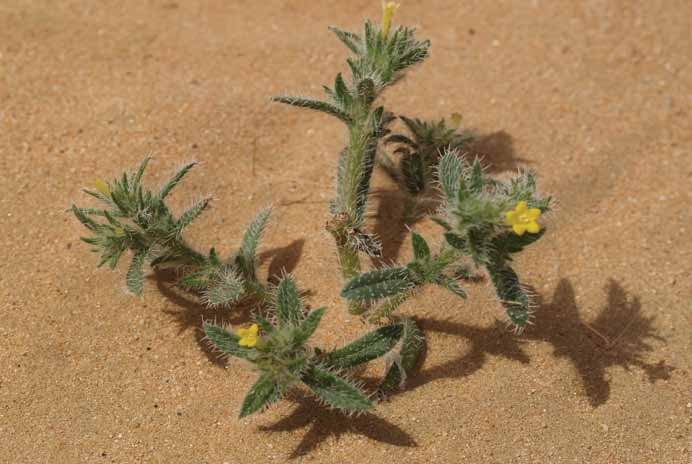
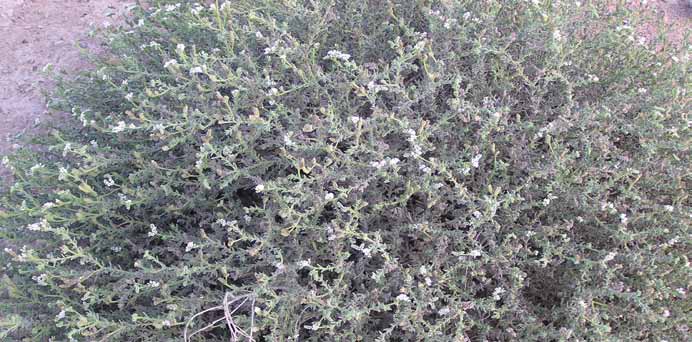
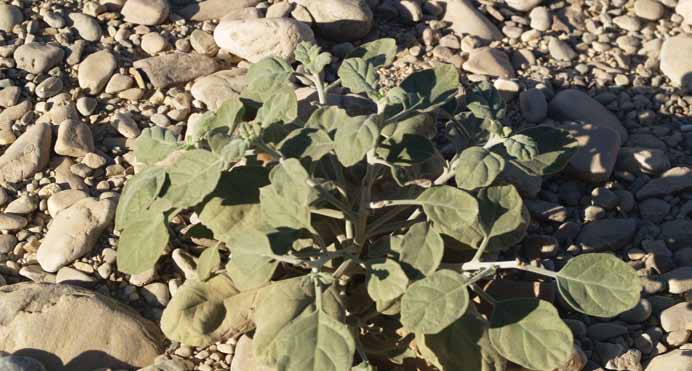
An erect, much-branched perennial herb. Young branches and leaves are covered with appressed two-armed hairs and short, simple white hairs with swollen bases; older branches are somewhat woody, young ones herbaceous and whitish-green. Leaves stalked, the lower ones up to 10 x 1.5 cm, oblong-lanceolate, entire. Inflorescence a forked (two-branched) cyme up to 25 cm long, sometimes with more than two branches from the same stalk. Flowers small, about 5 mm long, white. Calyx very small, about 1 mm, divided almost to the base into 5 lobes. Corolla about 5 mm long, the tube narrowed at the mouth and near the base so that it looks twice swollen, hairy outside, with spreading white lobes. Stamens 5, the anthers placed at the middle of the corolla tube. Stigma conical. Fruit of 4 nutlets about 2 mm long, each swollen at the side, green.
Habitat
Damp places and cultivated land in Oman according to the Omani field guide; elsewhere in its range a plant of seasonally dry tropical grassland and bushland.
Distribution
North-east tropical Africa (Sudan, South Sudan, Eritrea, Ethiopia, Djibouti, Somalia) south to Kenya, Uganda and Tanzania, also Angola, and the Arabian Peninsula (Oman, Saudi Arabia, Yemen).
Pastoral value
Rated as good grazing by the Omani field guide; no independent source on its forage value was found. Heliotropes in general contain pyrrolizidine alkaloids that can harm livestock eating them over long periods.
Other uses
No significant traditional or economic uses documented.
Sources
- الدليل الحقلي المصور للنباتات البرية في سلطنة عُمان (BOOK.pdf p.58)
- Plants of the World Online — Heliotropium longiflorum (A.DC.) Jaub. & Spach — powo.science.kew.org
- IVIS Guide to Poisonous House and Garden Plants — Heliotropium species (pyrrolizidine alkaloids, livestock) — ivis.org
- Heliotropium; a genus rich in pyrrolizidine alkaloids: a systematic review (record) — oalib-perpustakaan.upi.edu