
Arnebia hispidissima (Lehm.) A.DC.
حماط، هابرك، كحل، مليح
For people
- Eaten by people
- Not edible
- Toxic to people
- Unknown
For livestock
- Grazed by livestock
- Good fodder
- Toxic to livestock
- Unknown
Edibility and safety notes
Not eaten as food. The red root pigment is used as a dye and cosmetic and, in India, to colour food; the whole plant is boiled as a folk fever remedy. No safety data for people were found, and related Arnebia species contain liver-toxic pyrrolizidine alkaloids, so the plant should not be eaten or drunk as tea. It is palatable to livestock and grazed by sheep; no poisoning is reported.
This guide is a hobby project, not expert advice. Never eat a wild plant, or feed it to animals, on the strength of this page alone. Read the disclaimer
Description
An annual herb 2-20 cm tall, hispid with tubercle-based bristles and short hairs. Leaves are linear-lanceolate. Corolla is yellow, salver-shaped. Nutlets are pyramidal-ovoid, smooth or minutely tuberculate.
Habitat
Grows in sandy soils and rocky outcrops in desert or dry shrubland biomes. Typically blooms from March to May.
Distribution
Native range from North Nigeria to Tibet, including Arabia, North Africa and the Middle East.
Pastoral value
Palatable and grazed by sheep.
Other uses
The dark red roots yield a purplish-red dye (shikonin/alkannin pigments) used for dyeing cloth and silk, as a cosmetic, and in India (sold as 'ratanjot') for colouring food. In Arabia women formerly used the red root powder as a cosmetic. Traditionally used in India for ulcers, boils, cuts, sore throat, headache and fever, and in the Gulf the whole plant is boiled as a fever remedy.
Sources
- الدليل الحقلي المصور للنباتات البرية في سلطنة عُمان (BOOK.pdf p.55)
- PROTA / PlantUse — Arnebia hispidissima — plantuse.plantnet.org(PROTA)
- Encyclopedia of Medicinal Plants of UAE (DoH Abu Dhabi) — Arnebia hispidissima — medicinalplants.doh.gov.ae
- Qatar e-Nature — Arabian primrose (Arnebia hispidissima) — enature.qa
- Flora of Qatar — Arnebia hispidissima — floraofqatar.com
- PMC — Pyrrolizidine alkaloids and health risk of three Boraginaceae used in TCM (related Arnebia species) — ncbi.nlm.nih.gov
From the same family
All in this family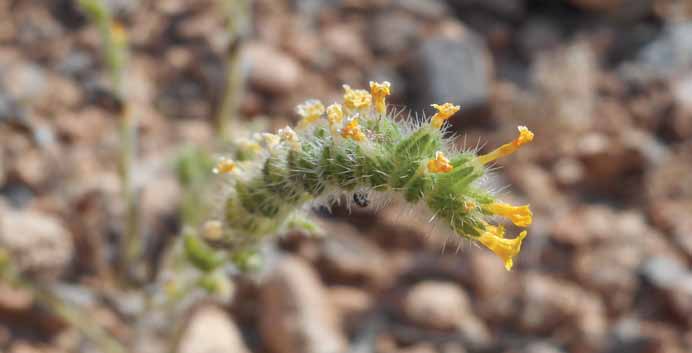
Boraginaceae
Arabian primrose
Arnebia decumbens (Vent.) Coss. & Kralik
Boraginaceae
Berry-bearing Heliotrope
Heliotropium bacciferum Forssk.
Boraginaceae
European Heliotrope, European Turn-sole
Heliotropium europaeum L.
Boraginaceae
Long-flowered Heliotrope
Heliotropium longiflorum (A.DC.) Jaub. & Spach