
Indigofera oblongifolia Forssk.
نيلة، حمري، سحي، حوير
For people
- Eaten by people
- Not edible
- Toxic to people
- Unknown
For livestock
- Grazed by livestock
- Limited fodder
- Toxic to livestock
- Not toxic
Edibility and safety notes
Not a food plant: no source records it being eaten, and its only internal uses are folk remedies, including the root as a strong purgative, so it should not be eaten or taken at home. Its toxicity to people has not been established either way. For livestock, the Omani field guide rates it as weak grazing, while Indian studies describe it as a useful browse shrub for sheep, goats and camels in arid areas; no poisoning from this species was found, although some other Indigofera species are toxic to livestock.
This guide is a hobby project, not expert advice. Never eat a wild plant, or feed it to animals, on the strength of this page alone. Read the disclaimer
Description
A silvery pubescent shrublet of the Fabaceae family, 1.5-3 m tall, with alternate oblong leaflets up to 35 x 12 mm. Many-flowered racemes usually less than 11 cm long. Pods are 12-18 mm, curved, reflexed, with 6-8 seeds.
Habitat
Sandy places; also rocky and roadside depressions and field margins in arid regions, tolerating some salinity.
Distribution
Native from West Tropical Africa to Egypt and Angola, Arabian Peninsula to the Indian subcontinent, extending east to Java.
Pastoral value
Rated as weak grazing by the Omani field guide. In the arid zone of India it is regarded as a useful browse shrub for sheep, goats and camels.
Other uses
The strong, flexible stems are used to make fish traps. Traditionally, a decoction of the stem was used as a gargle in mercury poisoning; the ground roots were applied as a paste to snake bites and other bites and stings to ease pain and swelling, used for rheumatism, and boiled with milk as a strong purgative; the leaves were used for wounds and dysentery, and the whole plant for enlargement of the spleen and liver and as a general antidote. The leaves are also reported to be used as a hair wash. These are records of folk use, not medical advice.
Sources
- الدليل الحقلي المصور للنباتات البرية في سلطنة عُمان (BOOK.pdf p.114)
- Plants of the World Online — Indigofera oblongifolia Forssk. — powo.science.kew.org
- Plant Genetic Resources (Cambridge) — Indigofera oblongifolia, an underutilized multiuse leguminous shrub of the Indian hot arid region — cambridge.org
- Indian Journal of Plant Genetic Resources — The Potential Uses of Indigofera L. in India — ispgr.in
- eNature Qatar — Indigofera oblongifolia — enature.qa
- USDA Dr. Duke's Phytochemical and Ethnobotanical Databases — Indigofera oblongifolia — phytochem.nal.usda.gov
From the same family
All in this family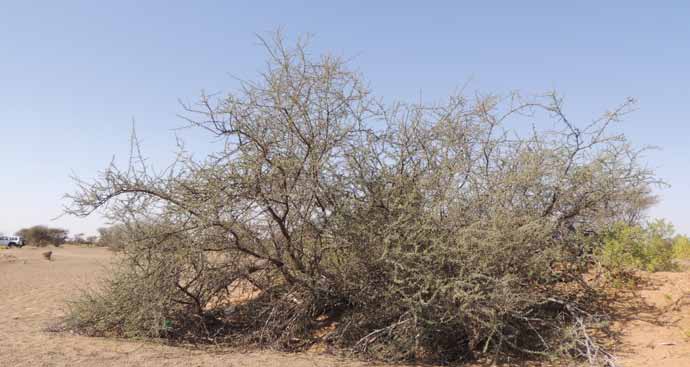
Fabaceae
Salam tree, Desert acacia
Acacia ehrenbergiana Hayne.
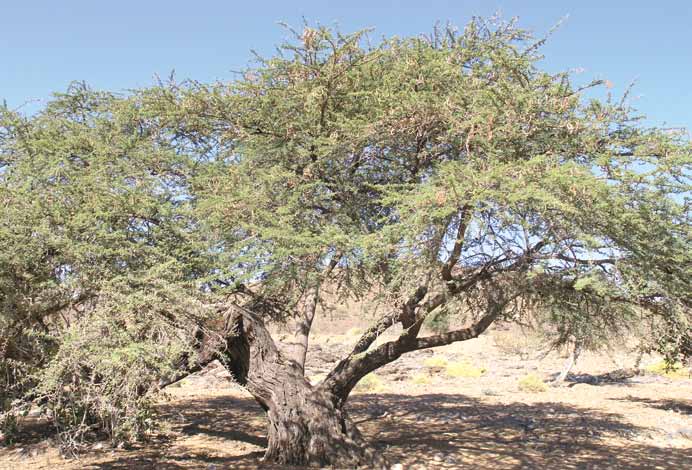
Fabaceae
Red thorn, Grey-haired acacia, Talh
Acacia gerrardii Benth.
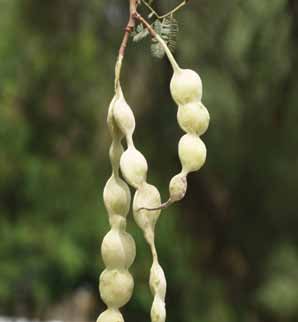
Fabaceae
Gum arabic tree, Babul, Thorn mimosa, Egyptian acacia, Thorny acacia
Acacia nilotica (L.) Del.
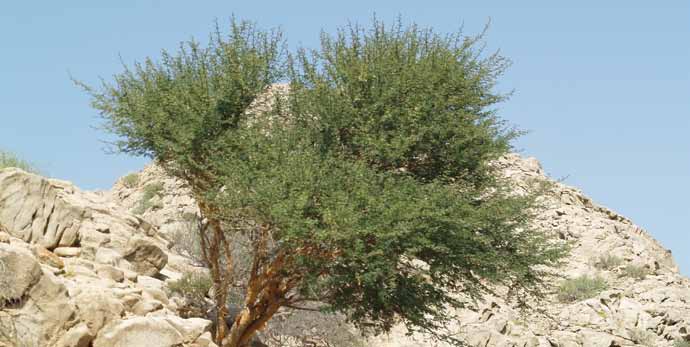
Fabaceae
Gum acacia, Gum arabic tree, Sudan gum
Acacia senegal (L.) Willd.